
1
PIP2-1-7 | Plasma membrane aquaporin isoforms 1-7, C-terminal
AS12 2110 | Clonality: Polyclonal | Host: Rabbit | Reactivity: L. sativa, P. sativum, S. lycopersicum, Z. mays
- Product Info
-
Immunogen: KLH-conjugated synthetic peptide derived from Zea mays PIP2-7 C-terminal, Q9ATM4, conserved also in Zea mays PIP2-1, UniProt: Q84RL7, PIP2-2, UniProt: Q9ATM8, PIP2-3 (80 % conservation) UniProt: Q9ATM7, PIP2-4 (80 % conservation) UniProt: Q9ATM6, PIP2-5 (70 % conservation) UniProt: Q9XF58, PIP2-6 (50 % conservation) UniProt: Q9ATM5
Host: Rabbit Clonality: Polyclonal Purity: Serum Format: Lyophilized Quantity: 50 µl Reconstitution: For reconstitution add 50 µl of sterile water Storage: Store lyophilized/reconstituted at -20°C; make aliquots to avoid repeated freeze-thaw cycles. Please remember to spin the tubes briefly prior to opening them to avoid any losses that might occur from material adhering to the cap or sides of the tube. Tested applications: Immunoprecipitation (IP), Western blot (WB) Recommended dilution: 1 : 600 (IP), 1: 3000 (WB) Expected | apparent MW: 30.7 | 30 kDa (Zea mays)
- Reactivity
-
Confirmed reactivity: Lactuca sativa, Pisum sativum, Solanum lycopersicum, Zea mays Predicted reactivity: Arabidopsis thaliana, Artemisia annua, Brassica oleracea, Capsicum annuum, Capsicum chinense, Cicer arietinum, Coffea arabica, Cucumis melo, Cucumis sativus, Fragaria chiloensis, Glycine max, Helianthus annuus, Hordeum vulgare, Malus prunifolia, Medicago trunculata, Mimosa pudica, Nicotiana tabacum, Noccaea caerulescens, Olea europaea, Oryza sativa, Phaseolus vulgaris, Pisum sativum, Prunus mume, Pyrus communis, Spinacia oleracea, Solanum lycopersicum, Solanum tuberosum, Trifolium repens, Triticum urartu, Triticum aestivum, Vitis vinifera
Species of your interest not listed? Contact usNot reactive in: Hordeum vulgare - Application Examples
-
Application example
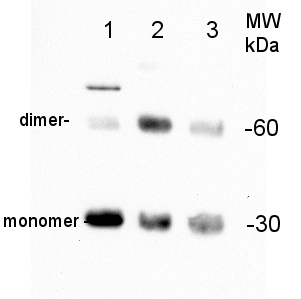
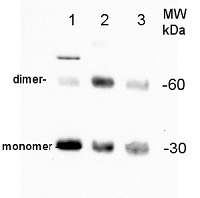
10 µg of total protein from Zea mays roots (1), Phaseolus vulgaris leaves (2) or roots (3) extracted with a mixture of 250 mM sorbitol, 50 mM Tris–HCl (pH 8), 2 mM EDTA, and protease inhibitors [1 mM phenylmethylsulfonyl Xuoride, 1 mg ml-1 each of leupeptin, aprotinin, antipain, chymostatin, and pepstatin were separated on 12 % SDS-PAGE and blotted 1h to PVDF. Blots were blocked with 5% milk in TBS-T for 2h at room temperature (RT) with agitation. Blot was incubated in the primary antibody at a dilution of 1: 3.000 for 1h at RT with agitation. The antibody solution was decanted and the blot was rinsed briefly twice, then washed four times for 5 min in TBS-T at RT with agitation. Blot was incubated in secondary antibody (goat anti-rabbit IgG horse radish peroxidase conjugated, from Agrisera AS09 602) diluted to 1:30 000 in TBS-T for 1h at RT with agitation. The blot was washed as above and developed for 5 min with ECL according to the manufacturers instructions. Exposure time was 60 seconds.
Courtesy of Dr. Ricardo Aroca, CSIC, Spain
- Additional Information
-
Additional information (application): Detection pattern consists of di and monomer of PIP2-7.
This antibody has a potential to work in immunolocalization studies, as it is recognizing C-terminal part of the sequence.
This product can be sold containing ProClin if requested.
- Background
-
Background: Plasma membrane aquaporin, PIP2;7 is water channel protein required for water transport across cell membrane.
Alternative names: plasma membrane intrinsic protein 2-7, AtPIP2;7, plasma membrane intrinsic protein 3, salt stress-induced major intrinsic protein, PIP3a - Product Citations
-
Selected references: Kumar et al. (2022). Proteomic dissection of rice cytoskeleton reveals the dominance of microtubule and microfilament proteins, and novel components in the cytoskeleton-bound polysome, Plant Physiology and Biochemistry, Volume 170,2022,Pages 75-86,ISSN 0981-9428, https://doi.org/10.1016/j.plaphy.2021.11.037.
- Protocols
-
Agrisera Western Blot protocol and video tutorials
Method for isolation of plant plasma membranes
.jpg)
Courtesy of Dr. Masayoshi Maeshima, Laboratory of Cell Dynamics, Graduate School of Bioagricultural Sciences Nagoya University Nagoya, Japan
- Reviews:
-
This product doesn't have any reviews.
Accessories
AS09 602 | Clonality: Polyclonal | Host: Goat | Reactivity: Rabbit IgG (H&L)
AS09 607 | Clonality: Polyclonal Host: Goat Reactivity: Rabbit IgG (H&L)