
1
Anti-ADH/ALDH | Alcohol/acetaldehyde dehydrogenase (bacterial/algal)
AS10 748 | Clonality: Polyclonal | Host: Rabbit | Reactivity: C. reinhardtii, E.coli
- Product Info
-
Immunogen: KLH-conjugated peptide derived from available algal and bacterial ADH sequences including Chlamydomonas reinhardtii
Host: Rabbit Clonality: Polyclonal Purity: Serum Format: Lyophilized Quantity: 200 µl Reconstitution: For reconstitution add 200 µl of sterile water Storage: Store lyophilized/reconstituted at -20°C; once reconstituted make aliquots to avoid repeated freeze-thaw cycles. Please remember to spin the tubes briefly prior to opening them to avoid any losses that might occur from material adhering to the cap or sides of the tube. Tested applications: Western blot (WB) Recommended dilution: 1 : 1000 (WB) Expected | apparent MW: 100 | 100 kDa (C.reinhardtii), 96 kDa (E.coli)
- Reactivity
-
Confirmed reactivity: Chlamydomonas reinhardtii, E.coli, Streptococcus pmenumoniae
Predicted reactivity: Algae, Lactococcus lactis, Nannochloropsis gaditana, Picochlorum sp.,
Species of your interest not listed? Contact usNot reactive in: Lactobacillus plantarum - Application Examples
-
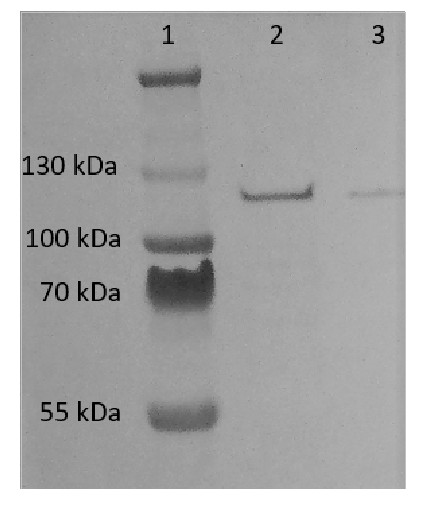
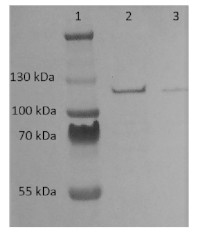
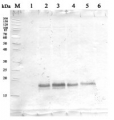
Samples:1 - Molecular marker
2 - Whole cell lysate, E.Coli (BL21) 10µl from OD=0,5
3 - Whole cell lysate, E.Coli (BL21) 3µl from OD=0,5
10 or 3 µg/well of total protein extracted from frozen E. coli pellet from 1 ml E.coli (BL21) pellet OD=0,5. Resuspended in 750µl PBS and vortexed briefly . Denatured by heating at 95 °C for 5 min. Samples were separated by NuPAGE 4-12% Bis-Tris Gel (NuPage MES SDS Running Buffer (20X))and blotted for 40 min to PVDF (pore size of 0,2 um), using: wet, transfer in RT. Blot was blocked with 5% milk in TBS-T for: 4°C/ON with agitation. Blot was incubated in the primary antibody at a dilution of 1:1000 for 1h/RT with agitation in TBS-T. The antibody solution was decanted and the blot was rinsed briefly twice, then washed once for 3 times for 5 min in TBS-T at RT with agitation. Blot was incubated in matching secondary antibody (anti-rabbit IgG ALP conjugated AS09 607) diluted to 1:5000 in5% milk in TBS-T 3 0min RT with agitation. The blot was washed 3x10min and developed with a following detection reagent: BCIP/NBT Plus, AS19 BCIP-NBT-PLUS . Exposure time was 5 minutes. Courtesy Agrisera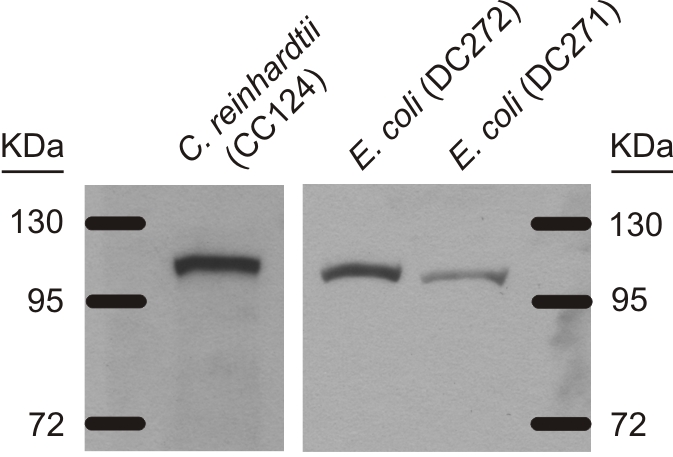
30 μg of a total cell extract from Chlamydomonas reinhardtii and E.coli strains DC272 and DC271 were loaded on Criterion™,Tris-HCl 10% polyacrylamide gels (Biorad) and molecular weight compared to those of the PageRuler™ Plus Prestained Protein Ladder (Fermentas). After SDS-PAGE, gels were transferred to PVDF membranes (Biorad) by the Trans-Blot SD semidry Transfer Cell method (Biorad) for 1 hour at 10V. Blocking of the PVDF membrane has been done for 3 hours in TBST milk 5% and has been followed by overnight incubation at 4°C with the primary anti-ADH/ALDH antibodies 1:1000 in TBST milk 1%. After three intensive washes, the membrane was incubated for one hour at room temperature with the secondary HRP-conjugated goat anti-rabbit (Agrisera AS09 602, in 1:50 000 dilution in TBST milk 1%). After three washes with TBST (10 minutes each), detection was achieved using chemiluminescent detection reagent. Exposure time was 2 minutes for Chlamydomonas reinhardtii sample and 10 seconds for E. coli samples.
E. coli strains DC272 and DC271 were provided by Professor David P. Clark, Souther Illinois University. The DC272 mutant strain is misregulated in AdhE expression so that the bacteria expresses the ADHE protein constitutively.
Courtesy Dr. Leonardo Magneschi, Scuola Superiore Sant'Anna, Italy
- Additional Information
-
Additional information: Selected peptide is well conserved in Escherichia coli ADHE (P0A9Q7), most of the microbial dual function aldehyde/alcohol dehydrogenases (ADHE) and Iron-containing alcohol dehydrogenases are also conserved in a peptide used to elicit ADH antibody - Background
-
Background: Alcohol dehydrogenase (E.C.:1.1.1.1) is an important enzyme for plants and microbes. In microalgae and bacteria the conversion of Acetyl-CoA to ethanol under conditions of oxygen deprivation is catalyzed by the dual function enzyme alcohol/acetaldehyde dehydrogenase (ADH/ALDH; E.C.:1.1.1.1 /1.2.1.10). This reaction results in NAD+ recycling and allows glycolysis to proceed.
- Product Citations
-
Selected references: Pony et al. (2020) Filamentation of the bacterial bi-functional alcohol/aldehyde dehydrogenase AdhE is essential for substrate channeling and enzymatic regulation. Nat Commun 11, 1426 (2020). doi: org/10.1038/s41467-020-15214-y
Kurylo et al. (2018). Endogenous rRNA Sequence Variation Can Regulate Stress Response Gene Expression and Phenotype. Cell Rep. 2018 Oct 2;25(1):236-248.e6. doi: 10.1016/j.celrep.2018.08.093.
Laurenceau et al. (2015). Conserved Streptococcus pneumoniae Spirosomes Suggest a Single Type of Transformation Pilus in Competence. PLoS Pathog. 2015 Apr 15;11(4):e1004835. doi: 10.1371/journal.ppat.1004835.
Kukuczka et al. (2014). Proton Gradient Regulation5-Like1-Mediated Cyclic Electron Flow Is Crucial for Acclimation to Anoxia and Complementary to Nonphotochemical Quenching in Stress Adaptation. Plant Physiol. 2014 Jun 19;165(4):1604-1617. - Protocols
-
Agrisera Western Blot protocol and video tutorials
Protocols to work with plant and algal protein extracts - Reviews:
-
This product doesn't have any reviews.
Related products
AS09 602 | Clonality: Polyclonal | Host: Goat | Reactivity: Rabbit IgG (H&L)
AS09 607 | Clonality: Polyclonal Host: Goat Reactivity: Rabbit IgG (H&L)
AS10 685 | Clonality: Polyclonal | Host: Rabbit | Reactivity:Arabidopsis thaliana, Oryza sativa, Phaseolus vulgaris, Solanum lycopersicum