
1
Anti-RPS14 | 40S ribosomal protein S14-1
AS12 2111 | Clonality: Polyclonal | Host: Rabbit | Reactivity: A. thaliana, Z. mays, C. reinhardtii, S. lycopersicum
- Product Info
-
Immunogen: KLH-conjugated synthetic peptide derived from a N-terminal of Arabidopsis thaliana Q9SIH0
Host: Rabbit Clonality: Polyclonal Purity: Immunogen affinity purified serum in PBS pH 7.4. Format: Lyophilized Quantity: 50 µg Reconstitution: For reconstitution add 50 µl of sterile water Storage: Store lyophilized/reconstituted at -20°C; make aliquots to avoid repeated freeze-thaw cycles. Please remember to spin the tubes briefly prior to opening them to avoid any losses that might occur from material adhering to the cap or sides of the tube. Tested applications: Western blot (WB) Recommended dilution: 1 : 1000 (WB) Expected | apparent MW: 16 | 15 kDa
- Reactivity
-
Confirmed reactivity: Arabidopsis thaliana, Chlamydomonas reinhardtii, Solanum lycopersicum, Zea mays Predicted reactivity: Brassica napus, Candidia albicans, Fusarium oxysporum, Lupinus luteus, Nannochloropsis gaditana, Nicotiana benthamiana, Ostreococcus tauri, Oryza sativa, Picea sitchensis, Populus trichocarpa, Sorghum bicolor, Ricinus communis, Chicken, Human, Mouse, Rat, Salmon, Trypanosoma brucei
Species of your interest not listed? Contact usNot reactive in: No confirmed exceptions from predicted reactivity are currently known - Application Examples
-
application example
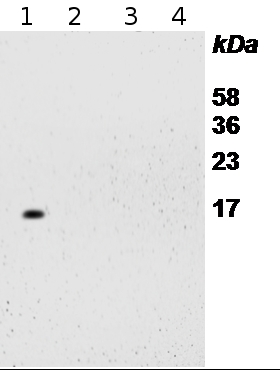
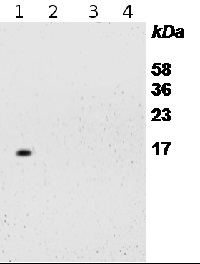
20 µg of total protein from Arabidopsis thaliana extracts from (1) total cell, nuclei (2), chloroplasts (3), thylakoids (4) were extracted with preparation buffer (330 mM sorbitol, 25mM Tricine pH 7.8, 1mM EDTA, 10mM KCl, 0,15% BSA, 4mM Na ascorbat and 7mM L-cysteine) and separated on 12 % sodium dodecyl sulfate polyacrylamide gel electrophoresis (SDS-PAGE) and blotted 1h 30min to Immobilon™PVDF (Millipore) membrane. Blots were blocked with 10% dry milk in Tris-buffered saline TBS-T (50 mM tris, 150 mM NaCl, pH 7.6 + 1ML 20% TWEEN 20) for 1h at room temperature (RT) with agitation. Blots were incubated in the primary antibody at a dilution of 1: 2 000 (in TBS-T) overnight at 4ºC with agitation. The antibody solution was decanted and the blot was rinsed briefly twice, and then washed once for 15 min and 3 times for 5 min in TBS-T at RT with agitation. Blot was incubated in secondary antibody (anti-rabbit IgG horse radish peroxidase conjugated, from Pierce) diluted to 1:20 000 in TBS-T for 1h at RT with agitation. The blot was washed as above and developed for 5 min with ThermoSuper Signal WestPico according to the manufacturers instructions. Exposure time was 3 minutes. Courtesy of Dr. Rikard Fristedt, UCLA, USA
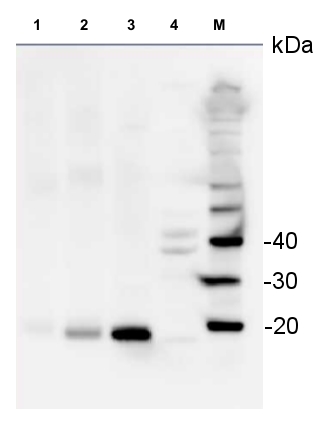
5 µg of total protein from Arabidopsis thaliana (1), Zea mays (2), Chlamydomonas reinhardtii (3), Salmo salar (4) extracted with PEB were separated on 4-12 % SDS-PAGE and blotted 1h to PVDF. Blots were blocked for 1h at room temperature (RT) with agitation. Blot was incubated in the primary antibody at a dilution of 1: 1 000 for 1h at RT with agitation. The antibody solution was decanted and the blot was rinsed briefly twice, then washed once for 15 min and 3 times for 5 min in TBS-T at RT with agitation. Blot was incubated in secondary antibody (anti-rabbit IgG horse radish peroxidase conjugated, from Agrisera, AS09 602) diluted to 1:25 000 in for 1h at RT with agitation. The blot was washed as above and developed for 5 min with ECL according to the manufacturers instructions. Exposure time was 2 minutes.
Application examples: 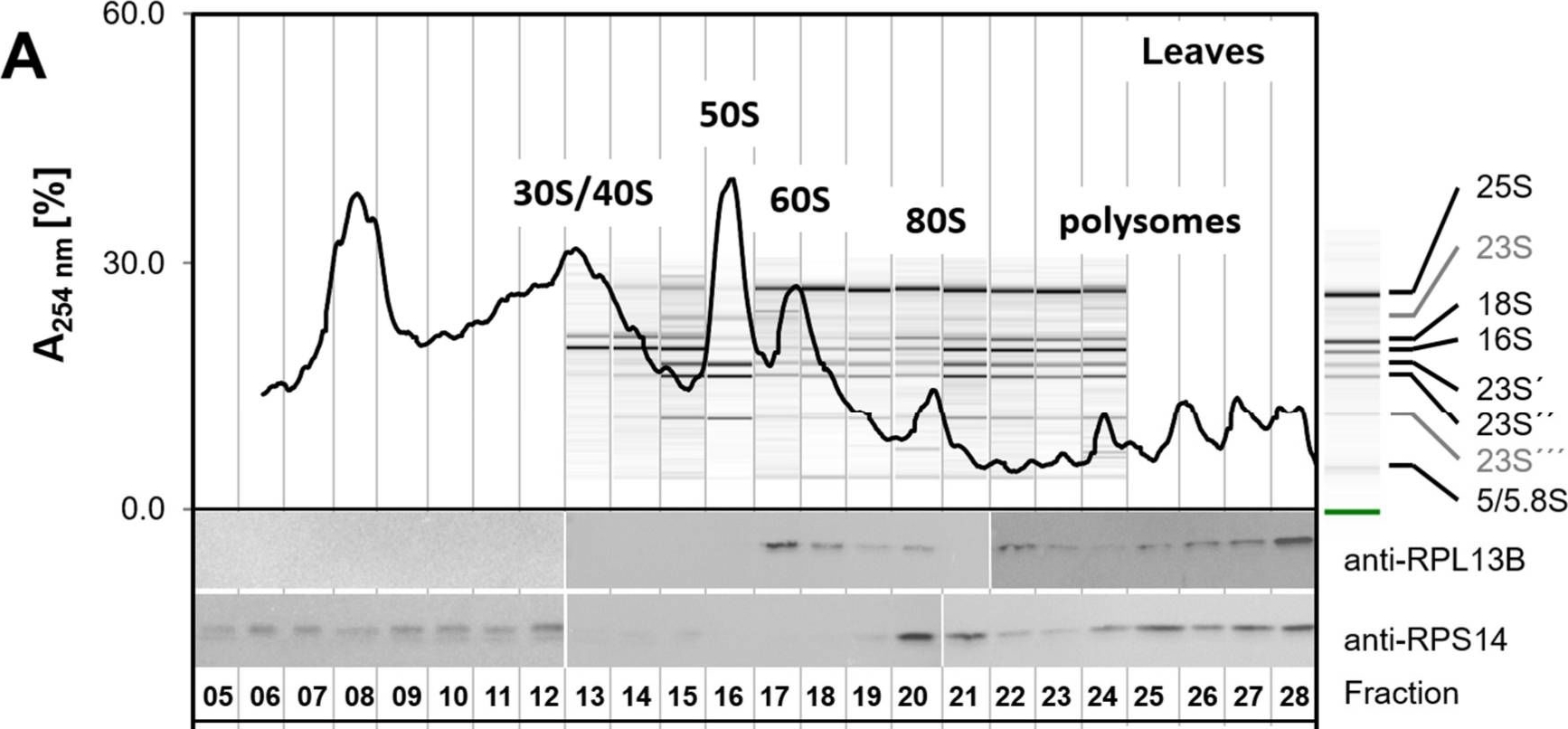
Reactant: Arabidopsis thaliana (Thale cress)
Application: Western Blotting
Pudmed ID: 32674508
Journal: Plants (Basel)
Figure Number: 2A
Published Date: 2020-07-14
First Author: Graf, A.
Impact Factor:
Open PublicationComparative examples of ribosome sedimentation profiles from diverse plant tissues. Ribosomes were prepared from 100 mg (fresh weight) of Arabidopsis thaliana Col-0 rosette leaves (A) or roots (B) of plants at the developmental stage ~1.10 [33] and (C) from 50 mg dry vernalized seeds. Ribosome subunit profiling was performed as described in this study using a 15–60% sucrose gradient and monitored by blank gradient subtracted absorbance at λ = 254 nm. rRNA was analyzed and annotated by single-sample scaled microfluidic electrophoresis of total RNA according to [36]. Note that root and seed materials other than leaf contain predominantly cytosolic ribosomes, as indicated by the 25S and 18S rRNA annotations to the right of subfigures B and C. Western blots of independent leaf ribosome preparations were probed with anti-RPL13B (At3g49010) and anti-RPS14A (AT2G36160) antibodies. White separators indicate independently hybridized Western blots. Approximate positions of fractions and UV traces were aligned by gradient elution- and fractionation-times. Note the occurrence of 18S rRNA in fraction F16 that is present in preparations of root and seed material and faintly in leaf material (black arrows). Moreover, note the co-occurrence of chloroplast rRNAs in leaf fractions F15 and following (A); plastid rRNAs are very low abundant in non-green tissues (B,C).
- Additional Information
-
Additional information (application): 20 µg of total protein is needed for detection of S14 in Arabidopsis thaliana - Background
-
Background: 40S ribosomal protein S14-1 is localized in cytoplasm and belongs to ribosomal protein S11P family.
- Product Citations
-
Selected references: Pereira Firmino et al. (2020). Separation and Paired Proteome Profiling of Plant Chloroplast and Cytoplasmic Ribosomes. Plants (Basel) . 2020 Jul 14;9(7):892.doi: 10.3390/plants9070892.
Ma et al. (2020). An ortholog of the Vasa intronic gene is required for small RNA-mediated translation repression in Chlamydomonas reinhardtii. Proc Natl Acad Sci U S A. 2020 Jan 7;117(1):761-770. doi: 10.1073/pnas.1908356117.
Shinozaki et al. (2020). Autophagy Increases Zinc Bioavailability to Avoid Light-Mediated ROS Production under Zn Deficiency. Plant Physiol. 2020 Jan 15. pii: pp.01522.2019. doi: 10.1104/pp.19.01522.
Wegener et al. (2019). Magnetic Tracking of Protein Synthesis in Microfluidic Environments-Challenges and Perspectives. Nanomaterials (Basel). 2019 Apr 9;9(4). pii: E585. doi: 10.3390/nano9040585.
Liu et al. (2018). Transcriptomics analyses reveal the molecular roadmap and long noncoding RNA landscape of sperm cell lineage development. Plant J. 2018 Jul 26. doi: 10.1111/tpj.14041.
Linster et al. (2015). Downregulation of N-terminal acetylation triggers ABA-mediated drought responses in Arabidopsis. Nat Commun. 2015 Jul 17;6:7640. doi: 10.1038/ncomms8640. - Reviews:
-
This product doesn't have any reviews.
Related products
AS09 602 | Clonality: Polyclonal | Host: Goat | Reactivity: Rabbit IgG (H&L)
AS15 3069 | Clonality: Polyclonal | Host: Rabbit | Reactivity: Arabidopsis thaliana
AS08 309 | Clonality: Polyclonal | Host: Rabbit | Reactivity: Synechocystis sp. , Sylindropspermopsis raciborskii CS-505