
1
HSP17,7 | Cytosolic class II heat shock protein 17,7
AS07 255 | Clonality: Polyclonal | Host: Rabbit | Reactivity: A. thaliana, A. tequiliana var. Weber, C. sativus, S. vulgaris, P. ternata
- Product Info
-
Immunogen: full length recombinant protein produced in E. coli and purified by conventional methods (no affinity tag). Arabidopsis thaliana Hsp17.7 CII (class two), UniProt: O81822, TAIR: At5g12030
Host: Rabbit Clonality: Polyclonal Purity: Serum Format: Lyophilized Quantity: 50 µl Reconstitution: For reconstitution add 50 µl of sterile water Storage: Store lyophilized/reconstituted at -20°C; once reconstituted make aliquots to avoid repeated freeze-thaw cycles. Please remember to spin the tubes briefly prior to opening them to avoid any losses that might occur from material adhering to the cap or sides of the tube. Tested applications: Western blot (WB) Recommended dilution: 1 : 1000 (WB) Expected | apparent MW: 17,7 kDa - Reactivity
-
Confirmed reactivity: Arabidopsis thaliana, Agave tequiliana var. Weber, Cucumis sativus, Medicago sativa, Pinellia ternata, Silene vulgaris
Predicted reactivity: Dicots, Fraxinus sp.
Species of your interest not listed? Contact usNot reactive in: Oryza sativam, Polyscias elegans
- Application Examples
-
Application example
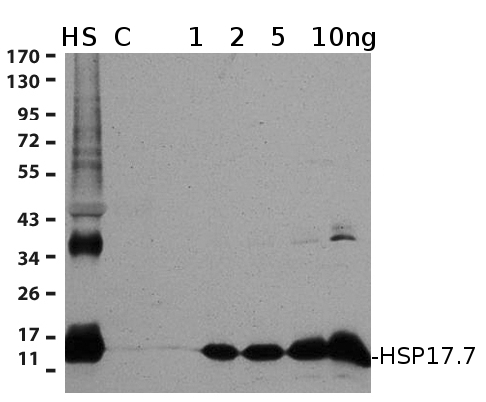
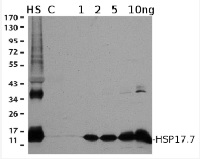
15 µg of total protein from (HS) heat shocked (38ºC/2h) Arabidopsis thaliana , (C) Arabidopsis thaliana control plants, (1,2,5,10) 1,2,5,10 ng of recombinant puridfied HSP17.7 were separated on 15% SDS-PAGE and blotted 1h to nitrocellulose (Biorad). Blots were incubated in the primary antibody at a dilution of 1: 1000 for 1h at room temperature with agitation and secondary HRP-conjugated antibody (1: 10 000). Development was done using chemiluminescent detection reagent, according to the recommendations of the manufacturers.
Image was acquired with a 10 sec exposure time on X-ray film (Kodak). Band at ~38 kDa represents and SDS resistant dimer. - Background
-
Background: Hsp17.7 belongs to a family of class II of a small heat shock proteins. They are induced once a plant cells are stressed by an increased temperature. The way small hsp proteins are protecting a living cell are not fully understood. They seem to be involved in chaperone functions by protecting other proteins from irreversible denaturation. Small hsp function also in a late seed maturation process.
- Product Citations
-
Selected references: Cha et al. (2020). Humic acid enhances heat stress tolerance via transcriptional activation of Heat-Shock Proteins in Arabidopsis. Sci Rep. 2020 Sep 14;10(1):15042.doi: 10.1038/s41598-020-71701-8.
McLoughlin et al. (2019) HSP101 Interacts with the Proteasome and Promotes the Clearance of Ubiquitylated Protein Aggregates. Plant Physiol. 2019 Aug;180(4):1829-1847. doi: 10.1104/pp.19.00263
Fu et al. (2019). Increased fes1a thermotolerance is induced by BAG6 knockout. Plant Mol Biol. 2019 Feb 22. doi: 10.1007/s11103-019-00844-8.
Korotaeva et al. (2018). Effect of Heat Hardening on Expression of Genes phb3 and phb4 and Accumulation of Phb Proteins in Green Leaves of Arabidopsis thaliana. Russian Journal of Plant Physiology, 65(5), 688-696, 2018. https://doi.org/10.1134/s1021443718040039
McLoughlin et al. (2016) Class I and II Small Heat Shock Proteins Together with HSP101 Protect Protein Translation Factors during Heat Stress. Plant Physiol. 2016 Oct;172(2):1221-1236. - Protocols
-
Agrisera Western Blot protocol and video tutorials
Protocols to work with plant and algal protein extracts
Agrisera Educational Posters Collection
- Reviews:
-
| 2011-10-04We tried we success this antibody in Medicago sativa, with 10 ug protein loading, with a 1/1000 dilution of primary antibody and 1/20000 secondary HRP, using ECL for detection
Accessories
AS07 254 | Clonality: Polyclonal | Host: Rabbit | Reactivity: A. thaliana, A. tequilana, B. juncea, Citrus sp., C. sativus, I. pumilla (perennial monocot), P. ternata, P. sylvestris, S. vulgaris, V. faba
AS08 286 | Clonality: Polyclonal | Host: Rabbit | Reactivity: Synechocystis sp. PCC 6803
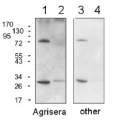
AS09 602 | Clonality: Polyclonal | Host: Goat | Reactivity: Rabbit IgG (H&L)