
1
HSP70 | Heat shock protein 70 (chloroplastic)
AS08 348 | Clonality: Polyclonal | Host: Rabbit | Reactivity: A. thaliana, H. vulgare, O. sativa, P. sativm, P. strobus
- Product Info
-
Immunogen: KLH-conjugated synthetic peptide derived from higher plant chloroplastic HSP70, inluding Arabidopsis thaliana cpHSC70-1, At4g24280 and cpHSC70-2, At5g49910
Host: Rabbit Clonality: Polyclonal Purity: Serum Format: Lyophilized Quantity: 200 µl Reconstitution: For reconstitution add 200 µl of sterile water Storage: Store lyophilized/reconstituted at -20°C; once reconstituted make aliquots to avoid repeated freeze-thaw cycles. Please remember to spin the tubes briefly prior to opening them to avoid any losses that might occur from material adhering to the cap or sides of the tube. Tested applications: Immunoprecipitation (IP), Western blot (WB) Recommended dilution: 1 : 100 (IP), 1 : 2000 (WB) Expected | apparent MW: 76 | 70 kDa
- Reactivity
-
Confirmed reactivity: Arabidopsis thaliana, Brassica napus, Hordeum spontaneum, Hordeum vulgare, Oryza sativa, Pinus strobus, Pisum sativum
Predicted reactivity: Arundo donax, Brachypodium distachyon, Brassica rapa subsp. pekinensis, Brassica napus, Capsella rubella, Citrus clementina, Citrus sinensis, Coffea canephora, Glycine max, Glycine soja, Hordeum vulgare, Medicago trancatula, Oryza sativa, Phaseolus vulgaris, Physomitrella patensm, Picea sitchemsis, Populus trichocarpa, Prunus persica, Ricinus communis, Solanum tuberosum, Solanum lycopersicum, Sorghum bicolor, Spinacia oleracea, Theobroma cacao, Triticum aestivum, Zea mays, Vitis vinifera
Species of your interest not listed? Contact usNot reactive in: No confirmed exceptions from predicted reactivity are currently known - Application Examples
-
Application example
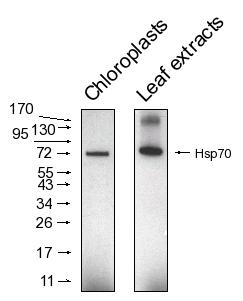
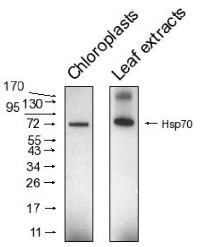
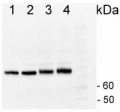
Total protein from Arabidopsis thaliana chloroplasts (20 µg) and ,Arabidopsis thaliana leaf extracts (25 µg) were separated on 10% acrilamide gel and electrophoresis prepared according to Schägger and von Jagov (Anl. Biochem., 1987, 166:368-379). After running the gel, proteins were transferred to nitrocellulose membrane using wet transfer (0.22% CAPS, pH 11). Transfer was checked by Ponceau S staining. Blot was destained by several quick washings in distilled water and 1 washing in 1X TBS (10 mM T pH 7.5, 150 mM NaCl) (10-15 min.).Blot was blocked by 1.5 hour in 5% milk in TBST (1X TBS, 0,1 20) After blocking blot was washed quickly twice in TBST and incubated 2 hours with primary antibody (dilution 1: 2000 TBST (dilution 1:1000). Washing: two quick washings in TBST and 3 x 10 min. washings in TBST. Then blot was incubated 45-60 min. with a secondary anti-rabbit antibodies conjugated to peroxidase (dilution 1:10000) in TBST. Washing: as above. After washing blot was incubated 1-2 min. in ECL solution and exposed to Kodak autoradiography film. Exposure time was 10 seconds.
Courtesy Dr. J. Piechota, Wrocław University, Poland
- Background
-
Background: Heat-shock protein 70 (Hsp70) is the major stress-inducible protein in vertebrates and is highly conserved throughout evolution. It plays a role as a molecular chaperone and is important for allowing cells to cope with acute stressor insult, especially those affecting the protein machinery. Heat shock cognate protein 70 (HSC70), is a highly conserved protein and a member of the family of molecular chaperones.
- Product Citations
-
Selected references: Chang et al. (2023). Chloroplast import motor subunits FtsHi1 and FtsHi2 are located on opposite sides of the inner envelope membrane. PNAS. 2023 Sep 12;120(37):e2307747120.doi: 10.1073/pnas.2307747120. Epub 2023 Sep 5.
Lee et al (2021). Chaperone-like protein DAY plays critical roles in photomorphogenesis. Nat Commun. 2021 Jul 7;12(1):4194. doi: 10.1038/s41467-021-24446-5. PMID: 34234144; PMCID: PMC8263706.
Jeran et al. (2021) The PUB4 E3 Ubiquitin Ligase Is Responsible for the Variegated Phenotype Observed upon Alteration of Chloroplast Protein Homeostasis in Arabidopsis Cotyledons. Genes (Basel). 2021 Sep 6;12(9):1387. doi: 10.3390/genes12091387. PMID: 34573369; PMCID: PMC8464772.
Dogra et al. (2019). Impaired PSII proteostasis triggers an UPR-like response in the var2 mutant of Arabidopsis thaliana. J Exp Bot. 2019 Apr 16. pii: erz151. doi: 10.1093/jxb/erz151.
Chen et al. (2018). TIC236 links the outer and inner membrane translocons of the chloroplast. Nature. 2018 Dec;564(7734):125-129. doi: 10.1038/s41586-018-0713-y.
Lentini et al. (2018). Early responses to cadmium exposure in barley plants: effects on biometric and physiological parameters. Acta Physiol Plant (2018) 40: 178. https://doi.org/10.1007/s11738-018-2752-2. - Protocols
-
Agrisera Western Blot protocol and video tutorials
Protocols to work with plant and algal protein extracts
Oxygenic photosynthesis poster by prof. Govindjee and Dr. Shevela
Z-scheme of photosynthetic electron transport by prof. Govindjee and Dr. Björn and Dr. Shevela - Reviews:
-
Zhao | 2020-05-11This antibody is really good. We used it for WB on Arabidopsis seedling samples with both 1:5000 and 1:10000. Stable and still working after 2 years storage at 4 degree.Pai-Hsiang Su | 2010-06-09This antibody AS08 348 is really good with its high specificity. I used it for immunoblotting with 1:2000 dilution by the coloring method. With its high specificity, I also have successfully used this antibody for immunoprecipitaion. In my practice, this antibody can reconize plastid Hsp70 well in both Arabidopsis and pea.
Accessories
AS08 347 | Clonality: Polyclonal | Host: Rabbit | Reactivity: Arabidopsis thalian, Brassica oleracea, Hordeum vulagre
AS09 602 | Clonality: Polyclonal | Host: Goat | Reactivity: Rabbit IgG (H&L)
AS08 371 | Clonality: Polyclonal | Host: Rabbit | Reactivity: A. thaliana, B. juncea, B. oleracea, C. sativus, C. reinhardtii, D. subspicatus, E. tef, G. vermiculophylla, H. vulgare, M. sativa, O. sativa, P. kurroa, P. strobus, Salicornia sp., S. italica. S. vulgaris, S. lycopersicum, Trebouxia TR1 and TR9, T. aestivum, Z. mays, P. falciparum, V. faba
Benefits of using this antibody