
1
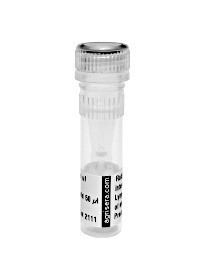
HSP90-1 | heat shock protein 90-1
AS08 346 | Clonality: Polyclonal | Host: Rabbit | Reactivity: A. thaliana, B. distachyon, Chlamydomonas sp. UWO241, H. vulgaris, Salicornia sp., S. lycopersicum, Z. mays
- Product Info
-
Immunogen: Full length recombinant Hsp90-1 from Arabidopsis thaliana, UniProt: P27323-1, TAIR: AT5G52640.
Host: Rabbit Clonality: Polyclonal Purity: Serum Format: Lyophilized Quantity: 50 µl Reconstitution: For reconstitution add 50 µl of sterile water Storage: Store lyophilized/reconstituted at -20°C; once reconstituted make aliquots to avoid repeated freeze-thaw cycles. Please remember to spin the tubes briefly prior to opening them to avoid any losses that might occur from material adhering to the cap or sides of the tube. Tested applications: Western blot (WB) Recommended dilution: 1 : 3000 (WB) Expected | apparent MW: 80.6 | 95 kDa (Arabidopsis thaliana)
- Reactivity
-
Confirmed reactivity: Arabidopsis thaliana, Brachypodium distachyon, Brassica napus, Chlamydomonas sp. UWO241, Fagopyrum esculentum, Hordeum vulgare, Salicornia sp., Solanum lycopersicum, Zea mays, Vicia faba
Predicted reactivity: Fraxinus sp., Glycne max, Linum usitatisimum, Micromonas pulsilla, Nicotiana benthamina, Nicotiana tabacum, Oryza sativa, Ostreococcus lucimarinus, Physcomitrium patens, Populus balsamifera, Ricinus communis, Solanum tuberosum, Sorghum bicolor, Triticum aestivum, Zea mays, Vitis vinifera
Species of your interest not listed? Contact usNot reactive in: No confirmed exceptions from predicted reactivity are currently known - Application Examples
-
Application examples: 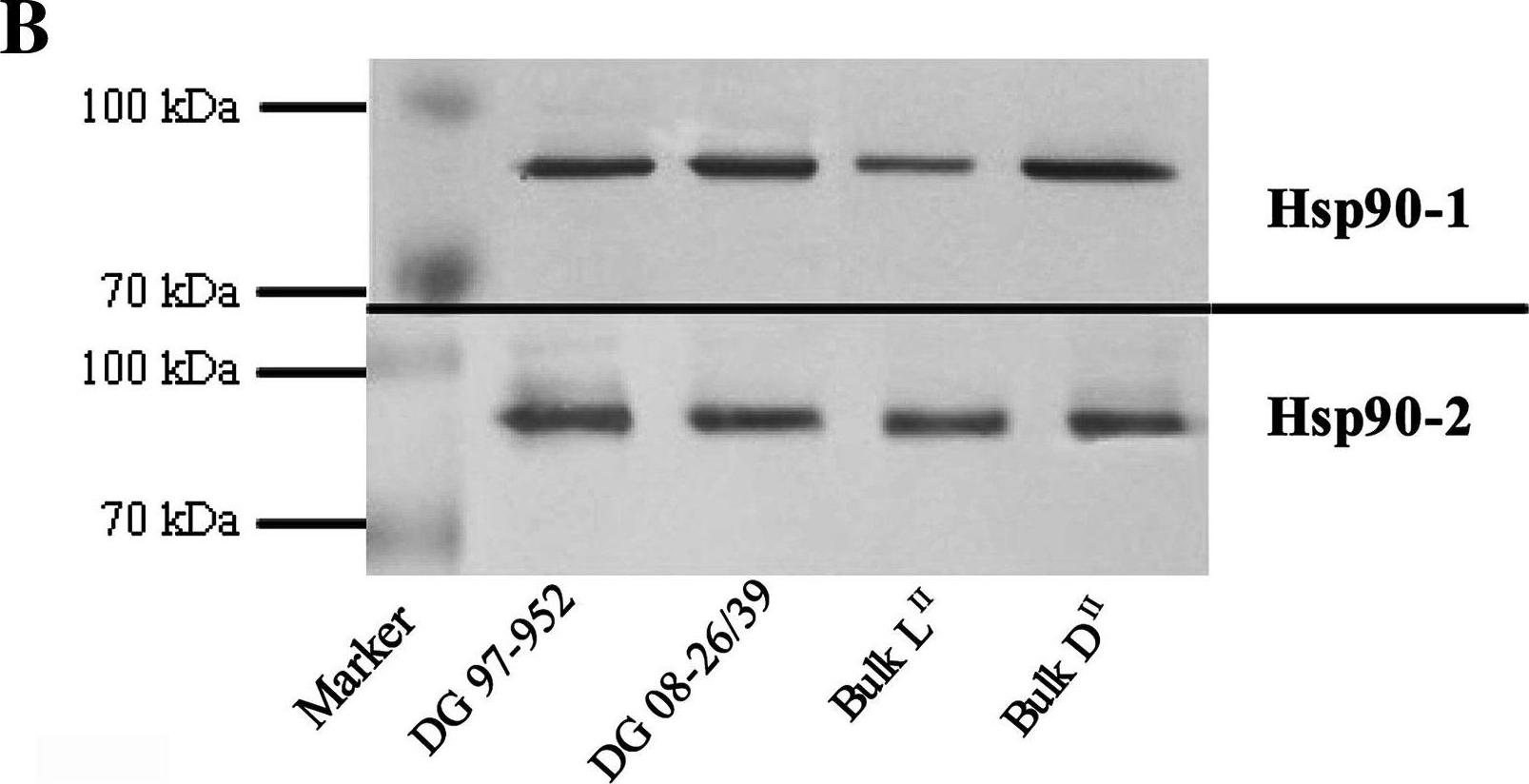
Reactant: Solanum tuberosum (Potato)
Application: Western Blotting
Pudmed ID: 26612975
Journal: Mol Breed
Figure Number: 3B
Published Date: 2015-11-28
First Author: So?tys-Kalina, D., Szajko, K., et al.
Impact Factor: 2.533
Open Publicationa Expression level of the Hsp90 gene in tubers after cold storage (CS); ns non-significant differences between parental clones (Student’s t test); a and b homogenous groups between bulk samples LII and DII (Tukey’s test). b Amounts of Hsp90-1 and Hsp90-2 protein isoforms in tubers after cold storage (CS); Marker—Prosieve® QuadColor™ Protein Marker. Parental clones: DG 97-952 (chip color 7) and DG 08-26/39 (chip color 4); bulk samples: LII (chip color 8–9) and DII (chip color 1–3)
- Additional Information
-
Additional information: Antibody is recognizing both, heat inducible Hsp90-1 and constitutive isofrom Hsp90-2. Both proteins have ca. 85 % similarity.
This product can be sold containing ProClin if requested - Background
-
Background: HSP90-1 (heast shock protein 90-1) is an isoform involved in response to bacterium, arsenic and heat. Synonymes: ATHS83; ATHSP90.1; F6N7.13; F6N7_13; HEAT SHOCK PROTEIN 81-1; HEAT SHOCK PROTEIN 83; HEAT SHOCK PROTEIN 90.1; HSP81-1; HSP81.1; HSP83.
- Product Citations
-
Selected references: Llamas et al. (2023). In planta expression of human polyQ-expanded huntingtin fragment reveals mechanisms to prevent disease-related protein aggregation. Nat Aging. 2023 Nov;3(11):1345-1357.doi: 10.1038/s43587-023-00502-1.
Kis et al. (2023). Targeted mutations in the GW2. 1 gene modulate grain traits and induce yield loss in barley. Plant Science Available online 27 December 2023, 111968.
Szadeczky-Kardoss et al. (2022) Elongation factor TFIIS is essential for heat stress adaptation in plants. Nucleic Acids Res. 2022 Feb 28;50(4):1927-1950. doi: 10.1093/nar/gkac020. PMID: 35100405; PMCID: PMC8886746.
Bychkov et al. (2022) The role of PAP4/FSD3 and PAP9/FSD2 in heat stress responses of chloroplast genes. Plant Sci. 2022 Sep;322:111359. doi: 10.1016/j.plantsci.2022.111359. Epub 2022 Jun 20. PMID: 35738478.
Cvetkovska et al. (2022) A constitutive stress response is a result of low temperature growth in the Antarctic green alga Chlamydomonas sp. UWO241. Plant, Cell & Environment, 45, 156– 177. https://doi.org/10.1111/pce.14203
Mishra et al. (2021) Interplay between abiotic (drought) and biotic (virus) stresses in tomato plants. Mol Plant Pathol. 2021 Dec 30. doi: 10.1111/mpp.13172. Epub ahead of print. PMID: 34970822.
Shteinberg et al. (2021) Tomato Yellow Leaf Curl Virus (TYLCV) Promotes Plant Tolerance to Drought. Cells. 2021 Oct 25;10(11):2875. doi: 10.3390/cells10112875. PMID: 34831098; PMCID: PMC8616339. - Protocols
-
Agrisera Western Blot protocol and video tutorials
Protocols to work with plant and algal protein extracts
Agrisera Educational Posters Collection - Reviews:
-
Ernesto Llamas | 2023-06-21I used this antibody for detecting Hsp90-1 in Arabidopsis thaliana tissues and works very well. I load a total of 25ug of protein using a dilution 1:3000 of the antibody for developing western blots.
Ernesto Llamas- University of Cologne
Accessories
AS06 174 | Clonality: Polyclonal | Host: Rabbit | Reactivity: Chlamydomonas reinhardtii
AS09 602 | Clonality: Polyclonal | Host: Goat | Reactivity: Rabbit IgG (H&L)
AS11 1629 | Clonality: Polyclonal | Host: Rabbit | Reactivity: Arabidopsis thaliana, Sorghum bicolor