
1
3-nitroY | Nitrotyrosine (25 µg)
AS10 706-25 | Clonality: monoclonal | Host: Mouse | Reactivity:nitrotyrosine
- Product Info
-
Immunogen: BSA-conjugated 3-(4-Hydroxy-3-nitrophenyl
acetamido) propionic acidSub class: IgG2A Host: Mouse Clonality: Monoclonal Purity: Total IgG. Protein G purified, in PBS. Contains 50 % glycerol and 0.09% sodium azide. Format: Liquid Quantity: 25 µg Storage: Store at -20°C; once reconstituted make aliquots to avoid repeated freeze-thaw cycles. Please remember to spin the tubes briefly prior to opening them to avoid any losses that might occur from material adhering to the cap or sides of the tube. Tested applications: ELISA (ELISA), Flowcyt (Flow cytometry), Immunocytochemistry (ICC), Immunohistochemistry (IHC), Immunoprecipitation (IP), Western blot (WB) Recommended dilution: 1: 100 (IHC), 1: 1400 (WB), The exact and optimal working dilution should be determined by the investigator - Reactivity
-
Confirmed reactivity: Dog, Human, Mouse, Rat Predicted reactivity: Higher plants Not reactive in: No confirmed exceptions from predicted reactivity are currently known - Application Examples
-
Application example 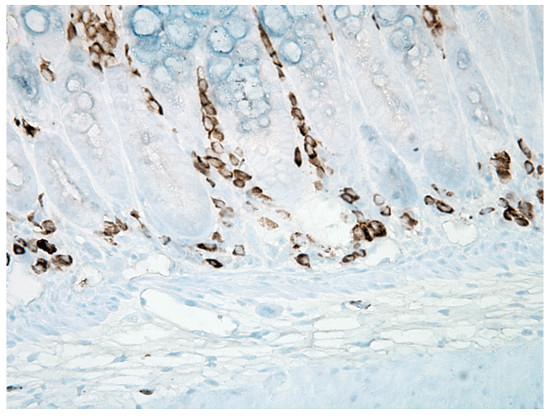
IHC using anti-Nitrotyrosine mouse monoclonal antibodies, Clone 39B6. Tissue: inflamed colon. Species: Mouse. Fixation: Formalin. Primary Antibody: Anti-Nitrotyrosine mouse monoclonal antibody Dilution: 1:1000000 for 12 h/4°C. Secondary Antibody: goat anti-Mouse biotin conjugated at 1:2000 1 h/RT. Counterstain: Mayer Hematoxylin (purple/blue) nuclear stain at 200 µl for 2 minutes at RT. Magnification: 40x. - Additional Information
-
Additional information: 1 mg/ml of Protein G purified IgG2A in PBS pH 7,4, 0,09 % sodium azide, 50 % glycerol Additional information (application): The antibody recognizes 3-nitrotyrosine moieties. No detectable crossreactivity with non-nitrated tyrosine. Not species specific.
0.7μg/ml was sufficient for detection of 5 μg SIN-1 treated BSA by Western Blot.
Antibody works paraffin-embedded sections. - Background
-
Background: Nitrotyrosine is a marker of NO-dependent oxidative stress. It is a product of tyrosine nitration mediated by reactive nitrogen species. Protein tyrosine nitration results in a post-translational modification, component of nitric oxide signaling.
- Product Citations
-
Selected references: Gow et al. (2004).Biological significance of nitric oxide-mediated protein modifications. Am J Physiol Lung Cell Mol Physiol. 287(2): L262-8.Antibody used in immunohistochemistry:
Pfister et al. (2002). Inducible nitric oxide synthase and nitrotyrosine in listeric encephalitis: a cross-species study in ruminants. Vet Pathol. 39: 190-199.
Girault et al. (2001).Immunodetection of 3-nitrotyrosine in the liver of zymosan-treated rats with a new monoclonal antibody: comparison to analysis by HPLC. Free Radical Biology and Medicine, 31 (11): 1375-1387.
- Protocols
-
Agrisera Western Blot protocol and video tutorials
Protocols to work with plant and algal protein extracts
Agrisera Educational Posters Collection - Reviews:
-
This product doesn't have any reviews.
Accessories
AS09 627 | Clonality: Polyclonal | Host: Rabbit | Reactivity: Mouse IgG (H&L)
AS10 706-100 | Clonality: monoclonal | Host: Mouse | Reactivity: nitrotyrosine

This product can be purchased in 3 different volumes:
AS16 ECL-S-10, 10 ml. Trial size limited to one per customer
AS16 ECL-S-100, 100 ml
AS16 ECL-S-1L, 1L
Choose the appropriate volume in the drop down menu to the right