
1
Anti-PIP2;2 | Plasma membrane aquaporin 2b
AS09 490 | Clonality: Polyclonal | Host: Rabbit | Reactivity: Arabidopsis thaliana, Raphanus sativus
Replaced by AS22 4813
- Product Info
-
Immunogen: KLH-conjugated synthetic peptide derived from N-terminal part of Raphanus sativus PAQ2b UniProt: Q9MB99
Host: Rabbit Clonality: Polyclonal Purity: Serum Format: Lyophilized Quantity: 100 µl Reconstitution: For reconstitution add 100 µl of sterile water Storage: Store lyophilized/reconstituted at -20°C; make aliquots to avoid repeated freeze-thaw cycles. Please remember to spin the tubes briefly prior to opening them to avoid any losses that might occur from material adhering to the cap or sides of the tube. Tested applications: ELISA (ELISA), Western blot (WB) Recommended dilution: 1 : 8000 (ELISA), 1 : 2000 (WB) Expected | apparent MW: 30 | 28 kDa (Raphanus sativus)
- Reactivity
-
Confirmed reactivity: Arabidopsis thaliana, Fragaria ananassa, Raphanus sativus Predicted reactivity: Brassica sp.
Species of your interest not listed? Contact usNot reactive in: No confirmed exceptions from predicted reactivity are currently known - Application Examples
-
Application example
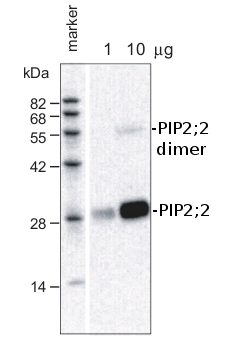
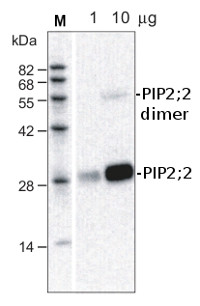
1 µg and 10 µg of crude membrane fraction/lane from Arabidopsis thaliana were separated on 12 % SDS-PAGE and blotted 1h to PVDF membrane (40 min. at 10 V using BioRad semidry transfer). Filters were blocked 1h with 5 % low-fat milk powder in TBS-T (0.05% Triton X.100). Membranes were washed 5 times with TBS-T, each time in a fresh polystyrene box and probed with anti-PIP2;2 antibodies (AS09 490, 1:1000, 1h) and secondary anti-rabbit (1:2000, 1 h). All steps were performed in RT with agitation.
PIP proteins usually show a faint band of dimeric form at 55 kDa addition to the major monomer band of 28 kDa even in the presence of SDS.
- Additional Information
-
Additional information: 0.1 % sodium azide is added as preservative. For antibody re-suspending information check the tube lable.
Antibodies will detect target protein in a few µg of a crude preparation loaded per well. If purified preparations of vacuolar and plasma membranes are used, one µg load per well should be sufficient.
Additional information (application): Protein or membrane sample should be treated at 70°C for 10 min before loading on the gel.
Antiboy will weakly react with PIP2;1 and theoretically with PIP2;3, however this protein is very scarcely expressed in plant tissues. The mRNA content is 1 % of that for PIP2;2, therefore reactivity to PIP2;3 was neglegible in our experiments.
Triton X-100 should not be included in the protein extraction buffer, when cell organelles or membrane proteins must be separated from soluble proteins. Because, Triton X breaks membrane structure and solubilizes most membranes proteins. Furthermore, it should be noted that Triton X at high concentrations binds SDS and mask the detergent effect of SDS for SDS-PAGE. Also, micelles of Triton X behave as a large complex with molecular mass of 90 kDa at high concentrations in SDS-PAGE.
- Background
-
Background: PIP2;2 is a plasma membrane aquaporin.
- Product Citations
-
Selected references: Brillada et al. (2020). Exocyst subunit Exo70B2 is linked to immune signalling and autophagy, The Plant Cell, 2020;, koaa022, https://doi.org/10.1093/plcell/koaa022
- Protocols
-
Agrisera Western Blot protocol and video tutorials
Protocols to work with plant and algal protein extracts
Agrisera Educational Posters CollectionMethod for isolation of plant plasma membranes
.jpg)
Courtesy of Dr. Masayoshi Maeshima, Laboratory of Cell Dynamics, Graduate School of Bioagricultural Sciences Nagoya University Nagoya, Japan
- Reviews:
-
This product doesn't have any reviews.
Related products
AS09 602 | Clonality: Polyclonal | Host: Goat | Reactivity: Rabbit IgG (H&L)
AS12 2110 | Clonality: Polyclonal | Host: Rabbit | Reactivity: L. sativa, P. sativum, S. lycopersicum, Z. mays