
1
Anti-V-ATPase, c | Vacuolar H+-ATPase, subunit c (16 kDa)
AS09 468 | Clonality: Polyclonal | Host: Rabbit | Reactivity: A. thaliana, M. crystallinum, N. tabacum
- Product Info
-
Immunogen: KLH-conjugated synthetic peptide derived from Arabidopsis thaliana V-ATPase subunit c UniProt: Q6IDA4, TAIR: AT2G16510
Host: Rabbit Clonality: Polyclonal Purity: Immunogen affinity purified serum in PBS pH 7.4. Format: Lyophilized Quantity: 50 µg Reconstitution: For reconstitution add 50 µl of sterile water Storage: Store lyophilized/reconstituted at -20°C; once reconstituted make aliquots to avoid repeated freeze-thaw cycles. Please remember to spin the tubes briefly prior to opening them to avoid any losses that might occur from material adhering to the cap or sides of the tube. Tested applications: Western blot (WB) Recommended dilution: 1 : 1000 (WB) Expected | apparent MW: 16 | 16 kDa (Arabidopsis thaliana)
- Reactivity
-
Confirmed reactivity: Arabidopsis thaliana, Mesembryanthemum crystallinum, Nicotiana tabacum Predicted reactivity: dictos including: Cucumis sativus, Gossypium mexicanum, Manihot esculenta, Phaseolus aureus, Raphanus sativus, Rcicinus communis, monocots including: Oryza sativa, Triticum aestivum, Zea mays, trees: Picea sitchensis, Populus trichocarpa
Species of your interest not listed? Contact usNot reactive in: Algae - Application Examples
-
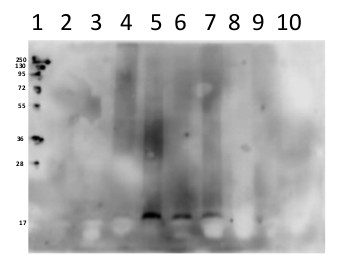
Application example 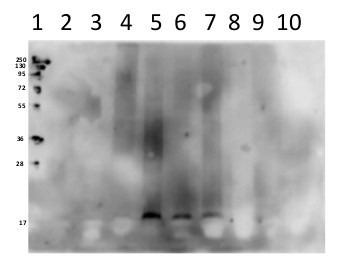 Following samples were analyzed: MW markers (1), Arabidopsis thaliana tonoplast (2), Arabidopsis thaliana plasma membrane (3), Arabidopsis thaliana microsomes (4), Arabidopsis thaliana total protein (5), Mesembryanthemum crystallinum tonoplast (6), Mesembryanthemum crystallinum plasma membrane (7), Mesembryanthemum crystallinum microsomes (8), Nicotiana tabacum microsomes (9), Brassica napus microsomes (10). 15 µg of the indicated protein, extracted according to Vera-Estrella et al. (2012) was separated on 12% SDS-PAGE and blotted 1.15h to PVDF using tank transfer. Blots were blocked with for 1h at room temperature (RT) with agitation. Blot was incubated in the primary antibody at a dilution of 1: 1 000 O/N at RT with agitation. The antibody solution was decanted and the blot was washed 3X for 15 min min in TBS-T at RT with agitation. Blot was incubated in secondary antibody (anti-rabbit IgG horse radish peroxidase conjugated, from Agrisera AS09 602 ) diluted to 1:50 000 in for 2h at RT with agitation. The blot was washed as above and developed using chemiluminescent substrated and recorder using the LiCOR c-DIGIT personal imager.Courtesy Dr. Bronwyn Barkla. UNAM, Mexico
 - Additional Information
-
Additional information: Subunit c is one of most hydrophobic proteins (can be dissolved in organic solvent such as a mixture of chloroform/methanol solution). It is prone to aggregation even in the presence of SDS. Therefore, before loading on the gel membrane fractions should be incubated in buffer containing 2 % SDS at 60° or 70°C for 10 min or at 25°C for 30 min.Additional information (application): Protein or membrane sample should be treated at 70°C for 10 min before loading on the gel - Background
-
Background: V-ATPase c subunit is located in vacuole and is involved in ATP synthesis cuopled proton transport. This protein is coded by ATVHA-C3 gene. Alternative names: AT4g34720/T4L20_300
- Product Citations
-
Selected references: Vera-Estrella et al. (2017). Cadmium and zinc activate adaptive mechanisms in Nicotiana tabacum similar to those observed in metal tolerant plants. Planta. 2017 Apr 28. doi: 10.1007/s00425-017-2700-1.
Barkla et al. (2016). Single-cell-type quantitative proteomic and ionomic analysis of epidermal bladder cells from the halophyte model plant Mesembryanthemum crystallinum to identify salt-responsive proteins. BMC Plant Biol. 2016 May 10;16(1):110. doi: 10.1186/s12870-016-0797-1. - Protocols
-
Agrisera Western Blot protocol and video tutorials
Protocols to work with plant and algal protein extracts
Oxygenic photosynthesis poster by prof. Govindjee and Dr. Shevela
Z-scheme of photosynthetic electron transport by prof. Govindjee and Dr. Björn and Dr. ShevelaMethod for isolation of plant vacuolar membranes
.jpg)
Courtesy of Dr. Masayoshi Maeshima, Laboratory of Cell Dynamics, Graduate School of Bioagricultural Sciences Nagoya University Nagoya, Japan
- Reviews:
-
This product doesn't have any reviews.
Related products
AS09 602 | Clonality: Polyclonal | Host: Goat | Reactivity: Rabbit IgG (H&L)
AS09 607 | Clonality: Polyclonal Host: Goat Reactivity: Rabbit IgG (H&L)