
1
Anti-eEF1B-beta1 and 2 | elongation factor 1-beta1 and 1-beta2
AS10 677 | Clonality: Polyclonal | Host: Rabbit | Reactivity: Arabidopsis thaliana
- Product Info
-
Immunogen: recombinant eEF1B-beta1 protein from Arabidopsis thaliana with no affinity tag, P48006, At1g30230
Host: Rabbit Clonality: Polyclonal Purity: Serum Format: Lyophilized Quantity: 200 µl Reconstitution: For reconstitution add 200 µl of sterile water Storage: Store lyophilized/reconstituted at -20°C; once reconstituted make aliquots to avoid repeated freeze-thaw cycles. Please remember to spin the tubes briefly prior to opening them to avoid any losses that might occur from material adhering to the cap or sides of the tube. Tested applications: Western blot (WB) Recommended dilution: 1 : 2000 (WB) Expected | apparent MW: 25 | 39 kDa
- Reactivity
-
Confirmed reactivity: Arabidopsis thaliana Predicted reactivity: Oryza sativa, Ricinus communis, Solanum tuberosum, Zea mays, Vitis vinifera
Species of your interest not listed? Contact usNot reactive in: No confirmed exceptions from predicted reactivity are currently known - Application Examples
-
Application example
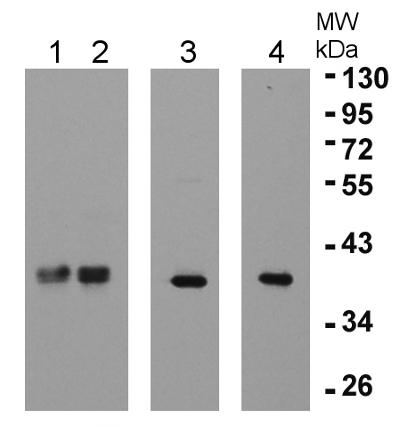
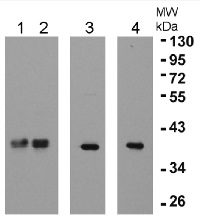
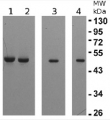
10 µg total protein extracted from 15 day old Arabidopsis thaliana seedlings that were either kept at 22ºC (1) or heat treated at 38ºC for 2 hours prior to protein extraction (2). As positive control 10 ng of recombinant elongation factor proteins beta 1 (3) and beta 2 (4) were separated side by side with the plant samples on 11% SDS-PAGE and blotted to nitrocellulose (Bio-rad). Blots were blocked following transfer with 5% low fat milk in low salt buffer for 1h at room temperature with agitation. Blots were incubated in the primary antibody at a dilution of 1: 2000 for 2h at room temperature with agitation in the blocking solution. The primary antibody solution was removed and the blot was rinsed briefly twice, then washed 4 times for 15 min each at room temperature with agitation using low salt buffer. Blots were incubated in secondary antibody (anti-rabbit IgG horse radish peroxides conjugated), diluted to 1:2500 for 1h at room temperature with agitation then washed as above and treated with ECL detection reagent according to the manufacturers instructions. Exposure time was 5 seconds. The primary antibody could be reused if it is kept at 4ºC for 2 weeks and if frozen at -20ºC for long time.
Low salt buffer components are 10 mM Tris (pH 7.6), 68 mM NaCl and 0.05 % Triton X-100.
- Additional Information
-
Additional information: Antibody is recognizing both proteins: elonagtion factor beta 1 and beta 2
- Background
-
Background: eEF1B-beta1 protein belongs to a family of elongation factors, proteins which are involved in translational elongation. Alternative names: Elongation factor 1-delta 1, EF-1-delta 1
- Product Citations
-
Selected references: McLoughlin et al. (2019) HSP101 Interacts with the Proteasome and Promotes the Clearance of Ubiquitylated Protein Aggregates. Plant Physiol. 2019 Aug;180(4):1829-1847. doi: 10.1104/pp.19.00263
McLoughlin et al. (2016) Class I and II Small Heat Shock Proteins Together with HSP101 Protect Protein Translation Factors during Heat Stress. Plant Physiol. 2016 Oct;172(2):1221-1236.
- Protocols
-
Agrisera Western Blot protocol and video tutorials
Protocols to work with plant and algal protein extracts
Agrisera Educational Posters Collection
- Reviews:
-
This product doesn't have any reviews.
Related products
AS09 602 | Clonality: Polyclonal | Host: Goat | Reactivity: Rabbit IgG (H&L)
AS09 607 | Clonality: Polyclonal Host: Goat Reactivity: Rabbit IgG (H&L)
AS10 676 | Clonality: Polyclonal | Host: Rabbit | Reactivity:Arabidopsis thaliana