
1

Anti-GR | Glutathione reductase
AS06 181 | Clonality: Polyclonal | Host: Rabbit | Reactivity: Arabidopsis thaliana, Catharanthus roseus,Glycine max, Hordeum vulgare, Medicago sativa, Nicotiana tabacum, Oryza sativa, Pisum sativum, Salicornia sp., Silene vulgaris, Scenedesmus quadricauda (algae), Solanum tuberosum, Spinacia oleracea, Zea mays
- Product Info
-
Immunogen: Maltose binding protein (MBP) fusion of Zea mays GR, O64409
Host: Rabbit Clonality: Polyclonal Purity: Total IgG. Protein G purified in PBS pH 7.4. Format: Lyophilized Quantity: 0.5 mg Reconstitution: For reconstitution add 100 µl of sterile water Storage: Store lyophilized/reconstituted at -20°C; once reconstituted make aliquots to avoid repeated freeze-thaw cycles. Please remember to spin the tubes briefly prior to opening them to avoid any losses that might occur from material adhering to the cap or sides of the tube. Tested applications: Immunolocalization (IL), Immunoprecipitation (IP), Western blot (WB) Recommended dilution: 2 µg (IP), 1 : 1000 (IL), 1 : 5000 (WB) Expected | apparent MW: 54 kDa
- Reactivity
-
Confirmed reactivity: Arabidopsis thaliana, Catharanthus roseus, Glycine max, Hordeum vulgare, Medicago sativa, Nicotiana tabacum, Oryza sativa, Pisum sativum, Salicornia sp., Silene vulgaris, Scenedesmus quadricauda (algae), Solanum tuberosum, Spinacia oleracea, Triticum aestivum, Zea mays Predicted reactivity: Brassica rapa, Marchantia polymorpha, Oryza sativa, Populus balsamifera
Species of your interest not listed? Contact usNot reactive in: No confirmed exceptions from predicted reactivity are currently known - Application Examples
-
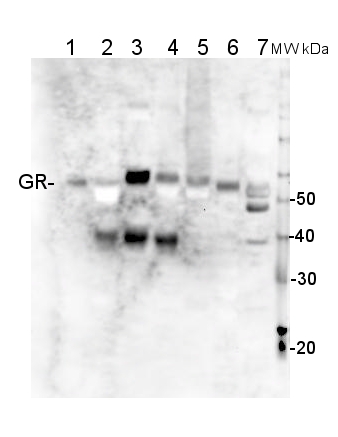
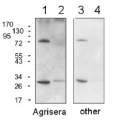
10 µg of total protein from (1) Arabidopsis thaliana leaf extracted with Protein Extration Buffer, PEB (AS08 300), (2) Nicotiana tabaccum leaf extracted with PEB, (3) Zea mays extracted with PEB, (4) Hordeum vulgare leaf extracted with PEB, (5) Physcomitrella patens total cell extracted with PEB, (6) Chlamydomonas reinhardtii total cell extracted with PEB, (7) Synochocystis elongatus total cell extracted with PEB, extracted with PEB, were separated on 4-12% NuPage (Invitrogen) LDS-PAGE and blotted 1h to nitrocellulose. Blots were blocked in 2 % low fat dry milk in TBS-T (0.1 % Tween 20) for 1h at room temperature with agitation. Blots were incubated in the primary antibody at a dilution of 1: 2000 for 1h at room temperature with agitation. The antibody solution was decanted and the blot was rinsed briefly twice, then washed once for 15 min and 3 times for 5 min in TBS-T at room temperature with agitation. Blots were incubated in secondary antibody (anti-rabbit IgG horse radish peroxidase conjugated) diluted to 1:30 000 for 1h at room temperature with agitation. The blots were washed as above and developed for 30 seconds with chemiluminescent detection reagent according the manufacturers instructions.
The nature of 40 kDa cross reaction in this experiment is not known.Application examples: 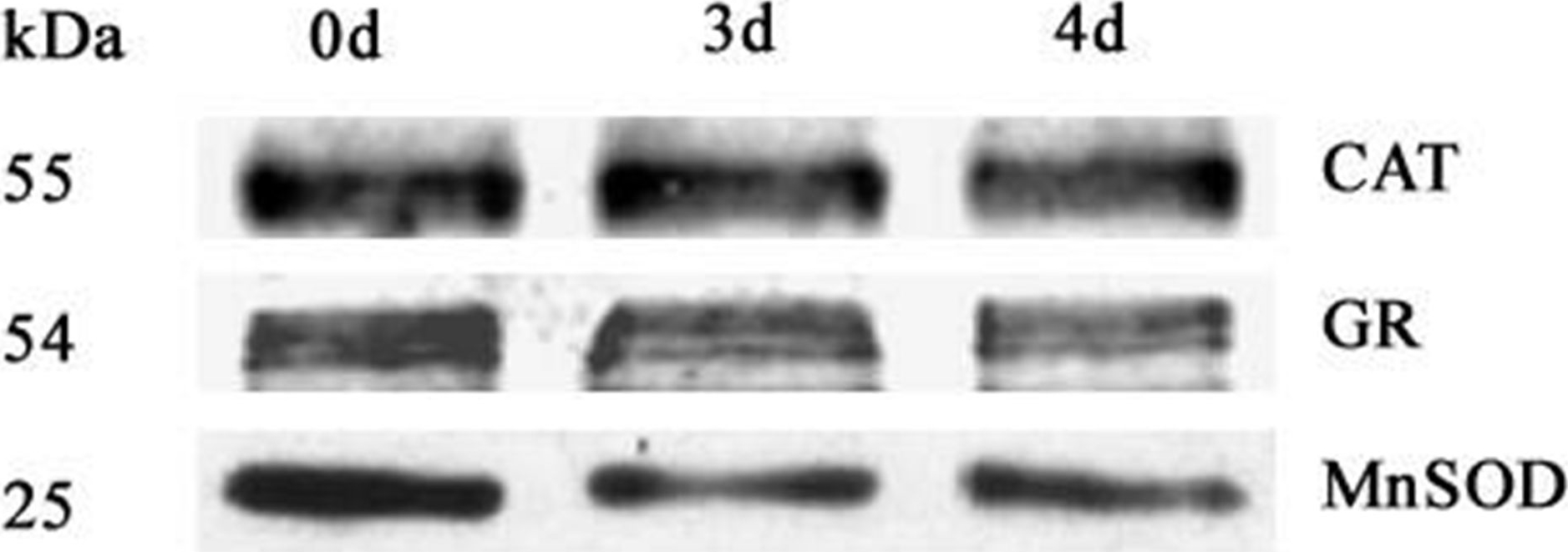
Reactant: Oryza sativa (Asian rice)
Application: Western Blotting
Pudmed ID: 27124767
Journal: PLoS One
Figure Number: 7A
Published Date: 2016-04-29
First Author: Yin, G., Whelan, J., et al.
Impact Factor: 2.942
Open PublicationWestern blot analysis of antioxidant enzymes in purified mitochondria from 0 d, 3 d, and 4 d aged seeds.Total 10 ?g protein was separated by SDS gel electrophoresis and blotted to supported polyvinylidene difluoride, then probed with antibodies against catalase (CAT), glutathione reductase (GR) and manganese superoxide dismutase (MnSOD).
- Additional Information
-
Additional information: Total IgG concentration is 7 µg/ µl
Additional information (application): This antibody will recognize the chloroplastic and cytoplasmic forms of the enzyme - Background
-
Background: Glutathione reductase (GR, EC 1.6.4.2) is an important enzyme for plant protection against environmental stress. It functions in plant defense reactions in the conversion of glutathione disulphide to reduced glutathione (GSH).
- Product Citations
-
Selected references: Xing et al. (2026). Transplanting light-dependent reactions for mammalian eye photosynthesis. Cell . 2026 May 15:S0092-8674(26)00469-1. doi: 10.1016/j.cell.2026.04.034.
Burian et al (2023) A prospective study of short-term apoplastic responses to ammonium treatment. J Plant Physiol. 2023 Jul;286:154008. doi: 10.1016/j.jplph.2023.154008.
Flores-Cáceres et al. (2023). The Early Oxidative Stress Induced by Mercury and Cadmium Is Modulated by Ethylene in Medicago sativa Seedlings. Antioxidants 2023, 12, 551.
Cembrowska-Lech, Rybak (2023) Nanopriming of Barley Seeds-A Shotgun Approach to Improve Germination under Salt Stress Conditions by Regulating of Reactive Oxygen Species. Plants (Basel). 2023;12(2):405. Published 2023 Jan 15. doi:10.3390/plants12020405
Borysiuk et al. (2022) Glyoxalase I activity affects Arabidopsis sensitivity to ammonium nutrition. Plant Cell Rep. 2022;41(12):2393-2413. doi:10.1007/s00299-022-02931-6
Bekturova et al. (2021) APS reductase and sulfite oxidase regulate sulfite-induced water loss in Arabidopsis. J Exp Bot. 2021 Jun 9:erab249. doi: 10.1093/jxb/erab249. Epub ahead of print. PMID: 34107028.
Zhong et al. (2020). Proteomic Analysis of Irradiation with Millimeter Waves on Soybean Growth under Flooding Conditions. Int J Mol Sci. 2020 Jan 12;21(2). pii: E486. doi: 10.3390/ijms21020486.
Ameri et al. (2020). Aluminium triggers oxidative stress and antioxidant response in the microalgae Scenedesmus sp. J Plant Physiol. 2020 Jan 15;246-247:153114. doi: 10.1016/j.jplph.2020.153114.
Zhong et al. (2019). Phosphoproteomics Reveals the Biosynthesis of Secondary Metabolites in Catharanthus roseus under Ultraviolet-B Radiation. J Proteome Res. 2019 Aug 7. doi: 10.1021/acs.jproteome.9b00267.
Balážová et al. (2018). Zinc oxide nanoparticles phytotoxicity on halophyte from genus Salicornia. Plant Physiol Biochem. 2018 Sep;130:30-42. doi: 10.1016/j.plaphy.2018.06.013.
Adhikari et al. (2018). Sulfate improves cadmium tolerance by limiting cadmium accumulation, modulation of sulfur metabolism and antioxidant defense system in maize. Environmental and Experimental Botany Volume 153, September 2018, Pages 143-162.
Yin et al. (2016). Comprehensive Mitochondrial Metabolic Shift during the Critical Node of Seed Ageing in Rice. PLoS One. 2016 Apr 28;11(4):e0148013. doi: 10.1371/journal.pone.0148013. eCollection 2016.
Hattab et al. (2015). Characterisation of lead-induced stress molecular biomarkers in Medicago sativa plants. Environm. Exp. Botany. Volume 123, March 2016, Pages 1–12.
Shaw et al. (2015). Beta-aminobutyric acid mediated drought stress alleviation in maize (Zea mays L.). Environ Sci Pollut Res Int. 2015 Sep 29.
Sobrino-Plata et al. (2014). Glutathione is a key antioxidant metabolite to cope with mercury and cadmium stress. Plant Soil, DOI 10.1007/s11104-013-2006-4.
Kovacik et al. (2013). Oxidative stress, uptake and bioconversion of 5-fluorouracil in algae. Chemosphere. 2013 Dec 28. pii: S0045-6535(13)01679-2. doi: 10.1016/j.chemosphere.2013.11.074. (immunolocalization in algae)
Sobrino-Plata et al. (2013). Specific stress responses to cadmium, arsenic and mercury appear in the metallophyte Silene vulgaris when grown hydroponically. RSC Advances, Jan 24. - Protocols
-
Agrisera Western Blot protocol and video tutorials
Protocols to work with plant and algal protein extracts
Agrisera Educational Posters Collection - Reviews:
-
Juande Alche | 2020-02-10The antibody cross react with a protein form of c.a. 54 kDa in olive pollen extracts after performing Western blotting experiments. We used the antibody at 1:1000 dilution with chemiluminescent detection. Loading was 30 micrograms per lane.| 2011-10-04We tried with success this antibody in Medicago sativa, with 10 ug protein loading, with a 1/5000 dilution of primary antibody and 1/20000 secondary HRP, suitable for ECL detectionJonas | 2010-11-27test
Related products
AS06 183 | Clonality: Polyclonal | Host: Rabbit | Reactivity: Brassica campestris, Nicotiana tabacum, Phaeodactylum tricornutum, Solanum lycopersicum, Zea mays
AS09 607 | Clonality: Polyclonal Host: Goat Reactivity: Rabbit IgG (H&L)
AS09 602 | Clonality: Polyclonal | Host: Goat | Reactivity: Rabbit IgG (H&L)
AS04 055 | Clonality: Polyclonal | Host: Rabbit | Reactivity: Arabidopsis thaliana
AS09 501 | Clonality: Polyclonal | Host: Rabbit | Reactivity: A.thaliana, A.madagascariensis, B. distachyon, B.oleracea, Cirtus sp., Fragaria x ananassa, H.vulgare, L. sativus, L. albus, M. perniciosa, N.bentamina, N.tabacum, O.sativa, P. kurroa, P.sativum, P. zeylandica, P.tomentosa, R.sativus, S. italica, S.lycopersicum, S.oleracea, T.aestivum, Z.mays, V. vinifera
Benefits of using this antibody