
1
Anti-HSP18,5 | class IV heat shock protein
AS11 1628 | Clonality: Polyclonal | Host: Rabbit | Reactivity: Arabidopsis thaliana, Hordeum vulgare
- Product Info
-
Immunogen: Recombinat Arabidopsis thaliana HSP18.5, expressed in E.coli, UniProt: O64564, TAIR: AT2G19310 Host: Rabbit Clonality: Polyclonal Purity: Serum Format: Lyophilized Quantity: 200 µl Reconstitution: For reconstitution add 200 µl of sterile water Storage: Store lyophilized/reconstituted at -20°C; once reconstituted make aliquots to avoid repeated freeze-thaw cycles. Please remember to spin the tubes briefly prior to opening them to avoid any losses that might occur from material adhering to the cap or sides of the tube. Tested applications: Western blot (WB) Recommended dilution: 1 : 1000 (WB) Expected | apparent MW: 18.5 kDa - Reactivity
-
Confirmed reactivity: Arabidopsis thaliana, Hordeum vulgare Predicted reactivity: Glycne max, Medicago truncatula, Medicago sativa, Pisum sativum, Ricinus communis, Rosa chinensis, Zea mays
Species of your interest not listed? Contact usNot reactive in: Prosopis cineraria - Additional Information
-
Additional information: As hsp18,5 is a low abundancy protein, please, make sure that the plants are heated to the right temperature, Normally I heat stress the seedling on a sealed agar plate for 2 hours, This assures that the humidity around the plant is very high, Low humidity can allow the plant to cool down through transpiration, If a plant is in soil you can keep the leaf or even a whole plant over a wet filter paper and seal the plate very well during the treatment, Heat stressing plants in microphage tubes does not work that well Additional information (application): Hsp 18.5 is a low abundancy protein and estimated concentration of this protein in total cell extract is ca. 0.007-0.01%. Therefore to be able to visualize this protein the load per well needs to be at least 20 ug of heat shocked total protein/well. It is crucial to heat treat the plants at 38ºC for 3 hours at high humidity.
Please, note that longer transfer time might result in losing a signal for this protein.
- Background
-
Background: HSP18.5 is a small heat shock protein localized in the cytoplasm. The protein belongs to HSP20 family and is involved in protein complex oligomerization and protein folding. Alternative names: AtHsp18.5, 18.5 kDa heat shock protein.
- Product Citations
-
Selected references: Sadura et al. (2020). HSP Transcript and Protein Accumulation in Brassinosteroid Barley Mutants Acclimated to Low and High Temperatures . Int J Mol Sci . 2020 Mar 10;21(5):1889.doi: 10.3390/ijms21051889. - Protocols
-
Agrisera Western Blot protocol and video tutorials
Protocols to work with plant and algal protein extracts
Agrisera Educational Posters Collection
- Reviews:
-
This product doesn't have any reviews.
Related products
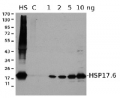
AS07 254 | Clonality: Polyclonal | Host: Rabbit | Reactivity: A. thaliana, A. tequilana, B. juncea, Citrus sp., C. sativus, I. pumilla (perennial monocot), P. ternata, P. sylvestris, S. vulgaris, V. faba
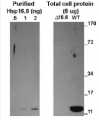
AS08 286 | Clonality: Polyclonal | Host: Rabbit | Reactivity: Synechocystis sp. PCC 6803
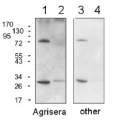
AS09 602 | Clonality: Polyclonal | Host: Goat | Reactivity: Rabbit IgG (H&L)