
1
Anti-GluTR | Glutamyl -tRNA reductase
AS10 689 | Clonality: Polyclonal | Host: Rabbit | Reactivity: Arabidopsis thaliana, Hordeum vulgare, Nicotiana tabacum
- Product Info
-
Immunogen: KLH-conjugated peptide derived from available glutamyl-tRNA reductase sequences including Arabidopsis thaliana P49294
Host: Rabbit Clonality: Polyclonal Purity: Serum Format: Lyophilized Quantity: 200 µl Reconstitution: For reconstitution add 200 µl of sterile water Storage: Store lyophilized/reconstituted at -20°C; once reconstituted make aliquots to avoid repeated freeze-thaw cycles. Please remember to spin the tubes briefly prior to opening them to avoid any losses that might occur from material adhering to the cap or sides of the tube. Tested applications: Western blot (WB) Recommended dilution: 1 : 5000 (WB) Expected | apparent MW: 58 | kDa (Arabidopsis thaliana)
- Reactivity
-
Confirmed reactivity: Arabidopsis thaliana, Hordeum vulgare, Nicotiana tabacum
Predicted reactivity: Brassica napus, Chlamydomonas reinhardtii, Cucumis sativus, Glycine max, Hordeum vulgare, Oryza sativa, Physcomitrium patens, Picea sitchensis, Pisum sativum, Populus trichocarpa, Solanum tuberosum, Sorghum bicolor, Ricinus communis, Zea mays, Vitis vinifera
Species of your interest not listed? Contact usNot reactive in: Cyanobacteria - Application Examples
-
application example
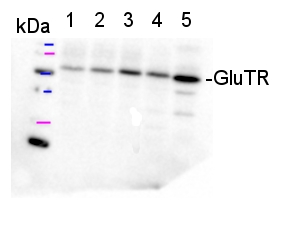
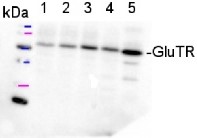
10 ul of leaf extract which was equivalent to 1 mg leaf material was loaded per lane, which may also correspond to approximately 50 ug protein. Arabidopsis thaliana seedlings were grown on vermiculite for 3 weeks under continuous illumination at a light intensity of 80 uE m-2 s-1 at 22°C. Twenty mg leaf material was collected from mature leaves and extracted with 200 ul of the tissue homogenization buffer. 10 ul of leaf extract which was equivalent to 1 mg leaf material was loaded per lane. Detection Protocol: Leaf protein was separated on 14% SDS-PAGE and blotted 2h to PVDF membrane from GE Healthcare. The blot was blocked with PBS-T (PBS plus 0.1% tween 20) containing 3% skim milk for 1h at room temperature (RT: approximately 22 degrees C) with gentle agitation. The blots were briefly washed twice with PBS-T and then incubated with anti-GluTR antibody which was diluted 1:1000 with PBS-T for 1h at RT with agitation. The primary antibody solution was decanted and the blot was rinsed twice, when washed once for 10 min and 3 times for 5 min in PBS-Tcontaining 0.5% (w/v) skim milk at RT with agitation. The blot was incubated with the secondary antibody (HRP-conjugated anti-rabbit IgG) which was diluted 1:20 000 with PBS-T containing 0.5% (w/v) skim milk for 1h at RT with agitation. The blot was washed as described above and incubated with Western Lightning Plus-ECL from Perkin-Elmer for 1 min. The chemiluminescent signal was captured with a CCD camera (LumiVision: Aisin Seiki Inc. Aichi, Japan) for 60 s.
Plant material grown for the experiment illustrated below: barley seeds were sawn on vermiculite and grown for 6 days in darkness at 22°C. Subsequently, seedlings were illuminated for 24 hours under a light intensity of 80 uE m-2 s-1. Approximately, 100 mg of Hordeum vulgare leaf material was harvested before illumination (1), and 2 h (2), 6 h (3) and 24 hours (4) after the onset of light; Arabidopsis thaliana wt (5). Each leaf material was extracted with 1 ml of the tissue homogenization solution (50 mM Tris Cl pH8.0, 2% Lithium Dodesyl Sulfate, 12% sucrose, 1.5% dithiothreitol).
Courtesy of Kaori TAKAHASHI and Ryouichi TANAKA (Hokkaido University)
- Additional Information
-
Additional information: Antibody reacts with recombinant GluTR isoforms: AtGluTR1, AtGluTR2 and NtGluTR1 (At - Arabidopsis thaliana, Nt - Nicotiana tabacum).
- Background
-
Background: GluTR (glutamyl tRNA reductase) belongs to a family of oxidoreductases and is involved in porphyrin and chlorophyll biosynthesis. This enzyme class is called L-glutamate-semialdehyde: NADP+ oxidoreductase (L-glutamyl-tRNAGlu-forming).
- Product Citations
-
Selected references: Pavlovič et al. (2024). Diethyl ether anaesthesia inhibits de-etiolation of barley seedlings by locking them in intermediate skoto-photomorphogenetic state. Physiol Plantarum, Volume176, Issue 1.
Agrawal et al. (2020). The Functions of Chloroplast Glutamyl-tRNA in Translation and Tetrapyrrole Biosynthesis. Plant Physiol. 2020 Feb 18. pii: pp.00009.2020. doi: 10.1104/pp.20.00009
Montandon et al. (2019). In vivo trapping of proteins interacting with the chloroplast CLPC1 chaperone; potential substrates and adaptors. J Proteome Res. 2019 May 9. doi: 10.1021/acs.jproteome.9b00112.
Nishimura et al. (2013). ClpS1 Is a Conserved Substrate Selector for the Chloroplast Clp Protease System in Arabidopsis. The Plant Cell June 2013. - Protocols
-
Agrisera Western Blot protocol and video tutorials
Protocols to work with plant and algal protein extracts
Agrisera Educational Posters Collection
- Reviews:
-
This product doesn't have any reviews.
Related products
AS09 602 | Clonality: Polyclonal | Host: Goat | Reactivity: Rabbit IgG (H&L)
AS09 607 | Clonality: Polyclonal Host: Goat Reactivity: Rabbit IgG (H&L)