
1
Anti-HSP101 | ClpB heat shock protein, N-terminal (rabbit antibody)
AS07 253 | Clonality: Polyclonal | Host: Rabbit | Reactivity: A.thaliana, A. tequilana var. Weber,B. oleracea, N. tabacum, O. sativa, S. lycopersicum, T. aestivum, T. salsuginea, V.faba
- Product Info
-
Immunogen: Recombinant Hsp101 N-terminal derived from the sequence of Arabidopsis thaliana Hsp101 protein P42730, At1g74310
Host: Rabbit Clonality: Polyclonal Purity: Serum Format: Lyophilized Quantity: 50 µl Reconstitution: For reconstitution add 50 µl of sterile water Storage: Store lyophilized/reconstituted at -20°C; once reconstituted make aliquots to avoid repeated freeze-thaw cycles. Please remember to spin the tubes briefly prior to opening them to avoid any losses that might occur from material adhering to the cap or sides of the tube. Tested applications: Western blot (WB) Recommended dilution: 1 : 1000 (WB) Expected | apparent MW: 101 kDa
- Reactivity
-
Confirmed reactivity: Arabidopsis thaliana, Agave tequilana,Brassica oleracea, Oryza sativa, Solanum lycopersicum, Thellungiella salsuginea, Triticum aestivum, Vicia faba
Predicted reactivity: Dicots, including: Glycine max, Vitis vinifera, monocots
Species of your interest not listed? Contact usNot reactive in: No confirmed exceptions from predicted reactivity are currently known - Application Examples
-
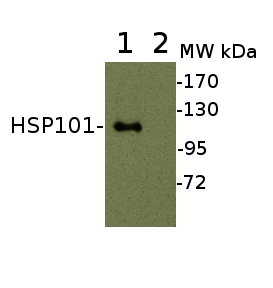
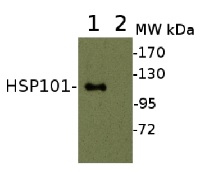
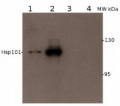
2 µg of total protein from (1) Arabidopsis thaliana WT stressed at 38ºC for 1.5 hour, (2) Arabidopsis thaliana HSP101 null mutant (hot 1-3) were separated on 7.5% SDS-PAGE and blotted 1h to nitrocellulose (Biorad). Blots were incubated in the primary antibody at a dilution of 1: 1 000 for 1h at room temperature with agitation and secondary HRP-conjugated antibody (1: 10 000).
Application examples: 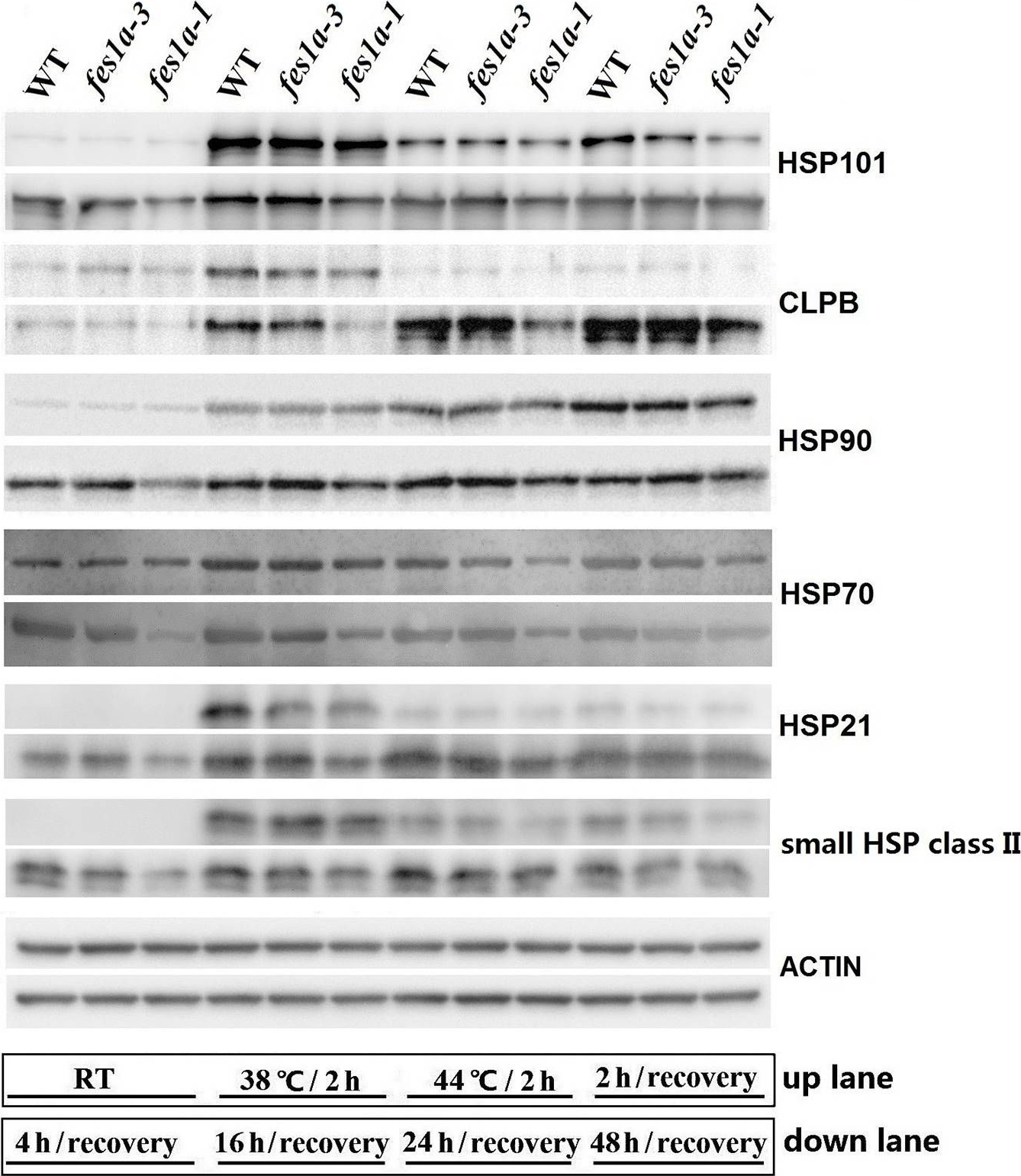
Reactant: Arabidopsis thaliana (Thale cress)
Application: Western Blotting
Pudmed ID: 32210987
Journal: Front Plant Sci
Figure Number: 5A
Published Date: 2020-03-27
First Author: Fu, C., Liu, X., et al.
Impact Factor: 5.435
Open PublicationThe expression of HSPs over the period from heat acclimation to the stage of recovery. Ten-day-old seedlings were first acclimated for 2 h at 38 °C, and then exposed to 44 °C for 2 h, and lastly returned to room temperature (RT) for recovery. At the indicated times (shown at the bottom of the picture), proteins were extracted for western blots. ACTIN was used as a loading control.
- Background
-
Background: Hsp101/ClpB is a member of HSP100 protein family. These proteins help protein aggregates formed during heat stress to fall apart to allow them to be refolded by other chaperones. HSP101 is a cytosolic heat shock protein required for acclimation to high temperature.
- Product Citations
-
Selected references: Szaker et al. (2025). Transcription fidelity and control of alternative splicing contribute to heat stress survival in Arabidopsis. Plant Cell. 2025 Oct 28:koaf256.doi: 10.1093/plcell/koaf256.
Li et al. (2025). Blocking constitutive autophagy rescues the loss of acquired heat resistance in Arabidopsis fes1a. New Phytologist, Volume245, Issue6 March 2025. Pages 2569-2583.
Szadeczky-Kardoss et al. (2022) Elongation factor TFIIS is essential for heat stress adaptation in plants. Nucleic Acids Res. 2022 Feb 28;50(4):1927-1950. doi: 10.1093/nar/gkac020. PMID: 35100405; PMCID: PMC8886746.
Wang et al. (2022) 17-(Allylamino)-17-demethoxygeldanamycin treatment induces the accumulation of heat shock proteins and alleviates senescence in broccoli. Postharvest Biology and Technology,Volume 186, 2022, 111818, ISSN 0925-5214, https://doi.org/10.1016/j.postharvbio.2021.111818.
Fedotova et al. (2020). Influence of high temperatures on heat tolerance and synthesis of heat shock proteins in spring wheat at the initial stages of development // Siberian Journal of Life Sciences and Agriculture. 2020. 12, 5. C. 179-191. DOI: 10.12731/2658-6649-2020-12-5-179-191
Gorovits et al. (2020). Pharmaceuticals in treated wastewater induce a stress response in tomato plants. Sci Rep. 2020 Feb 5;10(1):1856. doi: 10.1038/s41598-020-58776-z.
McLoughlin et al. (2019) HSP101 Interacts with the Proteasome and Promotes the Clearance of Ubiquitylated Protein Aggregates. Plant Physiol. 2019 Aug;180(4):1829-1847. doi: 10.1104/pp.19.00263 - Reviews:
-
This product doesn't have any reviews.
Related products
AS09 602 | Clonality: Polyclonal | Host: Goat | Reactivity: Rabbit IgG (H&L)
AS08 283 | Clonality: Polyclonal | Host: Chicken | Reactivity: Arabidopsis thaliana
AS01 001 | Clonality: Polyclonal | Host: Rabbit | Reactivity: A.thaliana, C.reinhardtii, cyanobacteria, Plectonema sp., Streptomyces sp.