
1
Anti-PsbH | Small subunit H of PSII
AS06 157 | Clonality: Polyclonal | Host: Rabbit | Reactivity: plants including A. balsamea, A.thaliana, H.vulgare, P.strobus, S.oleracea, Synechococcus sp. PCC 7942, Z.mays
- Product Info
-
Immunogen: KLH-conjugated synthetic peptide chosen from PsbH protein of Arabidopsis thaliana P56780, AtCg00710
Host: Rabbit Clonality: Polyclonal Purity: Serum Format: Lyophilized Quantity: 100 µl Reconstitution: For reconstitution add 100 µl of sterile water Storage: Store lyophilized/reconstituted at -20°C; once reconstituted make aliquots to avoid repeated freeze-thaw cycles. Please remember to spin the tubes briefly prior to opening them to avoid any losses that might occur from material adhering to the cap or sides of the tube. Tested applications: Immunoprecipitation (IP), Western blot (WB) Recommended dilution: 1 : 5000 (WB) Expected | apparent MW: 7.7 | 4 (Arabidopsis thaliana)
- Reactivity
-
Confirmed reactivity: Abies balsamea, Arabidopsis thaliana, Hordeum vulgare, Pinus strobus, Spinacia oleracea, Synechococcus sp. PCC 7942 Predicted reactivity: Cannabis sativa, Chlamydomonas reinhardtii, Glycine max, Nicotiana benthamiana, Nicotiana tabacum, Oryza sativa, Picea sitchensis, Pisum sativum, Populus deltoides, Solanum lycopersicum
Species of your interest not listed? Contact usNot reactive in: No confirmed exceptions from predicted reactivity are currently known - Application Examples
-
Application example

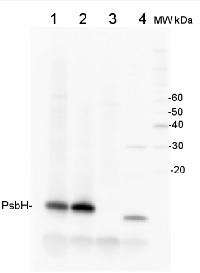
2 µg of total protein from (1) Arabidopsis thaliana leaf extracted with Protein Extration Buffer, PEB (AS08 300), (2) Hordeum vulgare leaf extracted with PEB, (3) Chlamydomonas reinhardtii total cell extracted with PEB, (4) Synechococcus sp. 7942 total cell extracted with PEB, (5) Anabaena sp. total cell extracted with PEB were separated on 4-12% NuPage (Invitrogen) LDS-PAGE and blotted 1h to PVDF. Blots were blocked immediately following transfer in 2% ECL Advance blocking reagent in 20 mM Tris, 137 mM sodium chloride pH 7.6 with 0.1% (v/v) Tween-20 (TBS-T) for 1h at room temperature with agitation. Blots were incubated in the primary antibody at a dilution of 1: 10 000 for 1h at room temperature with agitation. The antibody solution was decanted and the blot was rinsed briefly twice, then washed once for 15 min and 3 times for 5 min in TBS-T at room temperature with agitation. Blots were incubated in secondary antibody (anti-rabbit IgG horse radish peroxidase conjugated) diluted to 1:50 000 in 2% blocking solution for 1h at room temperature with agitation. The blots were washed as above and developed for 5 min with chemiluminescent detection reagent according the manufacturers instructions. Images of the blots were obtained using a CCD imager (FluorSMax, Bio-Rad) and Quantity One software (Bio-Rad). Exposure time was 1 second.
- Additional Information
-
Additional information: This product can be sold containing ProClin if requested
Additional information (application): LMW proteins can sometimes interfere with chlorophyll, but most chlorophyll can be removed by precipitating sample in acetone before loading on a gel.
Protocol:
Add acetone to final concentration of 80% ice-cold acetone.
Leave 10 minutes.
Spin.
Rresuspend pellet in solubilisation buffer and load on a gel. - Background
-
Background: The PsbH protein was originally named 10- or 9-kDa phosphoprotein in higher plant chloroplasts. It is encoded by the plastome in algae and higher plants. PsbH is also present in cyanobacteria, where it exhibits 56% amino acid identity with the corresponding protein from Arabidopsis. The protein contains 63–90 amino acids, depending on the species, with molecular masses between 7.0 and 9.9 kDa.
PsbH is an intrinsic membrane protein with a single transmembrane helix and its N-terminal region has been suggested to be exposed to the stromal side of the thylakoid membrane. Presence of PsbH already present in etiolated tissue can indicate that the protein may be involved in early stages of PSII assembly.
Obtained biochemical data from PSII complexes isolated from spinach suggest that PsbH, together with other PSII phosphoproteins, may be required for D1 protein turnover by regulating dimeric and monomeric PSII transition through their phosphorylation and dephosphorylation. - Product Citations
-
Selected references: Hackett et al. (2017). An Organelle RNA Recognition Motif Protein Is Required for Photosystem II Subunit psbF Transcript Editing. Plant Physiol. 2017 Apr;173(4):2278-2293. doi: 10.1104/pp.16.01623.
Levey et al. (2014). Expression of a nuclear-encoded psbH gene complements the plastidic RNA processing defect in the PSII mutant hcf107 in Arabidopsis thaliana. Plant J. 2014 Oct;80(2):292-304. doi: 10.1111/tpj.12632. Epub 2014 Sep 8.
Verhoeven et al. (2009). Seasonal changes in abundance and phosphorylation status of photosynthetic proteins in eastern white pine and balsam fir. Tree Physiol. 29:361-374. - Protocols
-
Agrisera Western Blot protocol and video tutorials
Protocols to work with plant and algal protein extracts - Reviews:
-
| 2011-12-01I forgot to mention: I work with Arabidopsis thaliana and the antibody shows a signal at 2,5 µg Protein of my wildtype sample. Pretty good.| 2011-11-30I used the PsbH antibody in a dilution of 1:2000 and it worked very well.
Related products
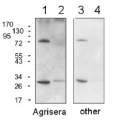
AS09 602 | Clonality: Polyclonal | Host: Goat | Reactivity: Rabbit IgG (H&L)
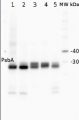
AS05 084 | Clonality: Polyclonal | Host: Rabbit | Reactivity: [global antibody] for higher plants, algae, liverwort, cyanobacteria, diatoms | cellular [compartment marker] of thylakoid membrane
Benefits of using this antibody
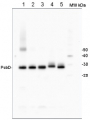
AS06 146 | Clonality: Polyclonal | Host: Rabbit | Reactivity: [global antibody] for A. thaliana, Anabaena 7120, D. brightwellii, H. vulgare, C.reinhardtii, C. zofingiensis, L. corniculatus, N. tabacum, O. sativa, P. sativum, P. vulgaris, P. tricornutum, T. pratense, S. alba, Synechococcus sp. PCC 7942, Synechocystis sp. PCC6803, T. guillardii, T. pseudonana, Triticale, U. prolifera, Z. mays
Benefits of using this antibody
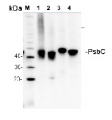
AS11 1787 | Clonality: Polyclonal | Host: Rabbit | Reactivity: A. thaliana, C.reinhardtii, C. zofingiensis, E. crus-galli, H. vulgare, O. sativa, P. ginseng, P. patens, P. sativum, P. vulgaris, P. yezoensis, Synochococcus sp. PCC7002, Synechocystis sp. PCC6803, T. aestivum, Triticale, Z. mays, V. lychnitis, V. radiate