
1
Anti-MnSOD | Manganese superoxide dismutase
AS09 524 | Clonality: Polyclonal | Host: Rabbit | Reactivity: A. thaliana, A. maritima, A. palmeri, B.napus, B. oleracea, Fragaria x ananassa, N. cataria, N. rtanjensis, O. sativa, P. sativum, R.sativus, Salicornia sp., S. oleracea, S. tuberosum
- Product Info
-
Immunogen: KLH-conjugated synthetic peptide derived from available MnSOD sequences in di and monocotyl plants including Arabidopsis thaliana O81235, At3g10920 Host: Rabbit Clonality: Polyclonal Purity: Serum Format: Lyophilized Quantity: 50 µl Reconstitution: For reconstitution add 50 µl of sterile water Storage: Store lyophilized/reconstituted at -20°C; once reconstituted make aliquots to avoid repeated freeze-thaw cycles. Please remember to spin the tubes briefly prior to opening them to avoid any losses that might occur from material adhering to the cap or sides of the tube. Tested applications: Western blot (WB) Recommended dilution: 1 : 2000-1 : 5000 (WB) Expected | apparent MW: 25 | 25 kDa
- Reactivity
-
Confirmed reactivity: Arabidopsis thaliana, Amaranthus palmeri, Armeria maritima, Brassica napus, Brassica oleracea, Camellia sinensis, Fragaria x ananassa, Lycopersicum esculentum, Iris pumila, Nepeta cataria, Nepeta rtanjensis, Oryza sativa, Pisum sativum, Raphanus sativus, Salicornia sp. , Solanum tuberosum, Spinacia oleracea, Stevia rebaudiana
Predicted reactivity: Glycine max, Gossipium mexicanum, Hordeum vulgare, Musa acuminata, Picea sitcHensis, Populus balsamifera sub. trichocarpa, Triticum aestivum, Vitis vinifera, Zea mays
Species of your interest not listed? Contact usNot reactive in: algae, Marchantia polymorpha, Prunus domestica - Application Examples
-
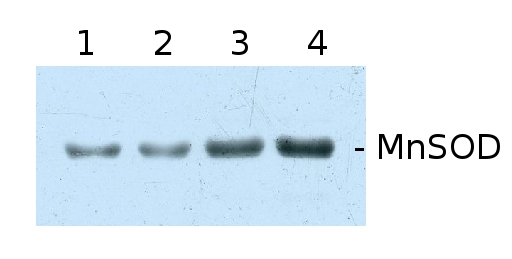
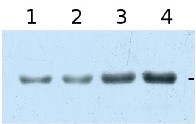
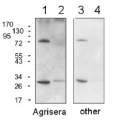
5 µg (1,2), 10 µg (3, 4) of total protein from Pisum sativum were separated on 12% SDS-PAGE and blotted 30 min. to PVDF. Blots were blocked (in 5% fat free milk) immediately following transfer in for 1h at RT with agitation. Blots were incubated in the primary antibody at a dilution of 1: 2 000 overnight in 4°C with agitation. The antibody solution was decanted and the blot was rinsed briefly twice, then washed 4 times for 5 min in TBS-T at RT with agitation. Blots were incubated in secondary antibody (anti- IgG horse radish peroxidase conjugated, from Agrisera, AS09 602) diluted to 1:20 000 for 1h at RT with agitation. The blots were washed 4 times for 5 min in TBS-T and 2 times for 5 min in TBS and developed for 1 min with ECL detection reagent according to the manufacturers instructions. Exposure time was 60 seconds.
Courtesy Dr. Elżbieta Romanowska, Warsaw University, Poland
Application examples: 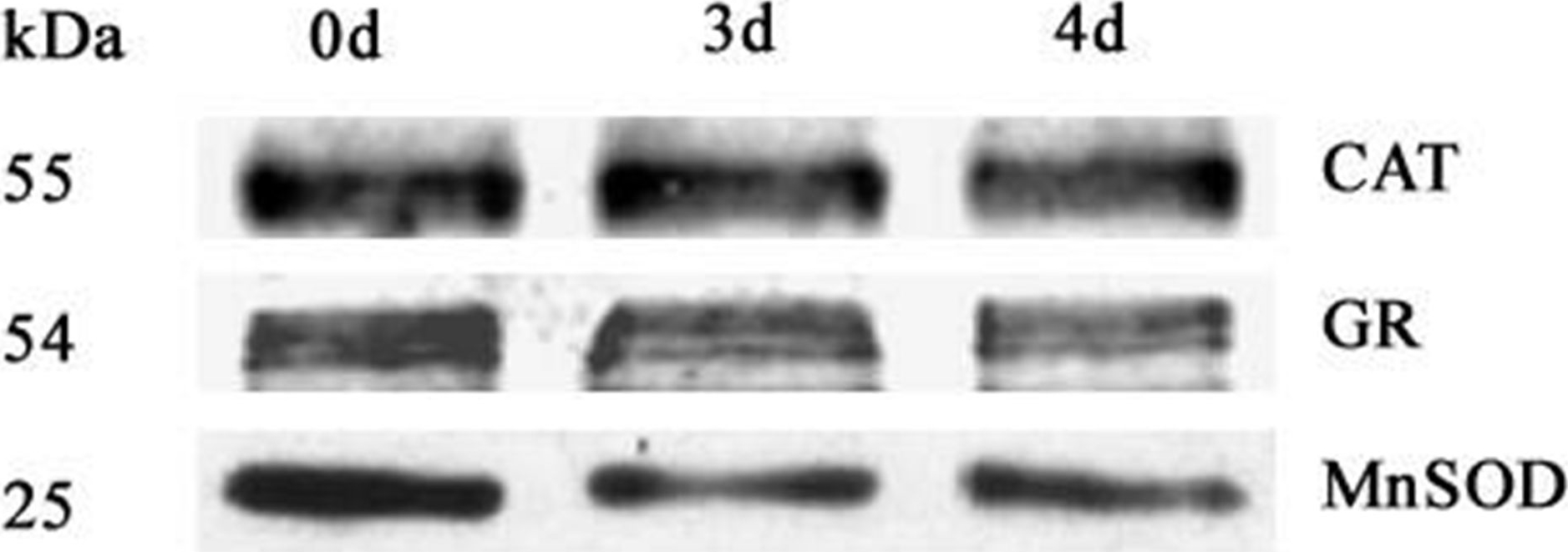
Reactant: Oryza sativa (Asian rice)
Application: Western Blotting
Pudmed ID: 27124767
Journal: PLoS One
Figure Number: 7A
Published Date: 2016-04-29
First Author: Yin, G., Whelan, J., et al.
Impact Factor: 2.942
Open PublicationWestern blot analysis of antioxidant enzymes in purified mitochondria from 0 d, 3 d, and 4 d aged seeds.Total 10 ?g protein was separated by SDS gel electrophoresis and blotted to supported polyvinylidene difluoride, then probed with antibodies against catalase (CAT), glutathione reductase (GR) and manganese superoxide dismutase (MnSOD).
- Additional Information
-
Additional information: Freshly prepared reducing agent like DTT needs to be used in a sample buffer, Otherwise MnSOD will migrate at 50 kDa - Background
-
Background: Plant MnSOD catalyzes the dismutation of superoxide to molecular oxygen and water. One subunit of the homotetramer complex binds 1 Mn cofactor. Antioxidant system works as a defense against oxidative stress. SOD (superoxide dismutase) catalyzes the dismutation of superoxide into oxygen and H,O,. SODs are classified, according to their metal cofactor, as FeSOD, MnSOD, or Cu / ZnSOD. Chloroplasts generally contain Cu/ZnSOD and, in a number of plant species, FeSOD. Synonymes: MSD1, SODA, SOD3
- Product Citations
-
Selected references: Piechowiak et al. (2025), Ozone Treatment Enhances Antioxidant Status and Energy Metabolism in Radish (Raphanus sativus) Sprouts. Springer Nature, Food Bioprocess Technology.
Mohapatra et al. (2025). An Improved Method for Isolating Intact Chloroplasts from Different Plant Species. Journal of Plant Growth Regulation, doi.org/10.1007/s00344-025-11911-4.
Wittmann at al. (2024).Dual plastid targeting of Protoporphyrinogen Oxidase 2 in Amaranthaceae promotes herbicide tolerance. Plant Physiol. 2024 Feb 8:kiae062.doi: 10.1093/plphys/kiae062.
Cembrowska-Lech, Rybak (2023) Nanopriming of Barley Seeds-A Shotgun Approach to Improve Germination under Salt Stress Conditions by Regulating of Reactive Oxygen Species. Plants (Basel). 2023;12(2):405. Published 2023 Jan 15. doi:10.3390/plants12020405.
Bastow et al. (2018). Vacuolar Iron Stores Gated by NRAMP3 and NRAMP4 Are the Primary Source of Iron in Germinating Seeds. Plant Physiol. 2018 Jul;177(3):1267-1276. doi: 10.1104/pp.18.00478.
Balážová et al. (2018). Zinc oxide nanoparticles phytotoxicity on halophyte from genus Salicornia. Plant Physiol Biochem. 2018 Sep;130:30-42. doi: 10.1016/j.plaphy.2018.06.013
Rurek et al. (2018). Mitochondrial Biogenesis in Diverse Cauliflower Cultivars under Mild and Severe DBalážová rought Involves Impaired Coordination of Transcriptomic and Proteomic Response and Regulation of Various Multifunctional Proteins. Preprints 2018, 2018010276 (doi: 10.20944/preprints201801.0276.v1).
Schimmeyer et al. (2016). L-Galactono-1,4-lactone dehydrogenase is an assembly factor of the membrane arm of mitochondrial complex I in Arabidopsis. Plant Mol Biol. 2016 Jan;90(1-2):117-26. doi: 10.1007/s11103-015-0400-4. Epub 2015 Oct 31.
Yin et al. (2016). Comprehensive Mitochondrial Metabolic Shift during the Critical Node of Seed Ageing in Rice. PLoS One. 2016 Apr 28;11(4):e0148013. doi: 10.1371/journal.pone.0148013. eCollection 2016.
Vuleta et al. (2016). Adaptive flexibility of enzymatic antioxidants SOD, APX and CAT to high light stress: The clonal perennial monocot Iris pumila as a study case. Plant Physiol Biochem. 2016 Mar;100:166-73. doi: 10.1016/j.plaphy.2016.01.011. Epub 2016 Jan 19
Dmitrović et al. (2015). Essential oils of two Nepeta species inhibit growth and induce oxidative stress in ragweed (Ambrosia artemisiifolia L.) shoots in vitro. Acta Physiologiae Plantarum, February 2015, 37:64.
Dimkovikj and Van Hoewyk (2014). Selenite activates the alternative oxidase pathway and alters primary metabolism in Brassica napus roots: evidence of a mitochondrial stress response. BMC Plant Biol. 2014 Sep 30;14:259. doi: 10.1186/s12870-014-0259-6.
Parys et al. (2014). Metabolic Responses to Lead of Metallicolous and Nonmetallicolous Populations of Armeria maritima. Arch Environ Contam Toxicol. 2014 Jul 29.
Momčilović et al. (2014). Improved procedure for detection of superoxide dismutase isoforms in potato, Solanum tuberosum L. Acta Physiologiae Plantarum, August 2014, Volume 36, Issue 8, pp 2059-2066.
Piechowiak et al (2023) Effect of postharvest nicotinamide treatment on NAD+ metabolism and redox status in strawberry fruit during storage. - Protocols
-
Agrisera Western Blot protocol and video tutorials
Protocols to work with plant and algal protein extracts
Oxygenic photosynthesis poster by prof. Govindjee and Dr. Shevela
Z-scheme of photosynthetic electron transport by prof. Govindjee and Dr. Björn and Dr. Shevela - Reviews:
-
This product doesn't have any reviews.
Related products
AS06 170 | Clonality: Polyclonal | Host: Rabbit | Reactivity: A.thaliana, A.maritima, B.juncea, D.sanguinalis, E.crus-galli, E.tef, I.pumila, H.vulgare, I. walleriana, L.formosana, N.cataria, M. sativa, N.rtanjensis, O.sativa, P.Sogo Yukidian cultivar V3, P.vulgaris, P.sativum, Populus sp., S.superba, S.lycopersicum, S.tuberosum, Z.mays
AS09 602 | Clonality: Polyclonal | Host: Goat | Reactivity: Rabbit IgG (H&L)
AS06 125 | Clonality: Polyclonal | Host: Rabbit | Reactivity: A. maritima, A. thaliana, B. juncea, Ch. reinhardtii, D. bardawil, D.salina, M. sativa, Morus spp.,O. sativa, Salicornia sp., S. tuberosum, winter triticale, S. oleracea, Z. mays