
1
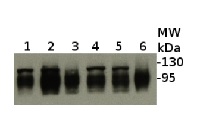
Anti-ClpB-P | ClpB3
AS09 459 | Clonality:Polyclonal | Host:Rabbit | Reactivity: Arabidopsis thaliana
- Product Info
-
Immunogen: KLH-conjugated peptide derived from ClpB-P of Arabidopsis thaliana Q9LF37, At5g15450
Host: Rabbit Clonality: Polyclonal Purity: Serum Format: Lyophilized Quantity: 100 µl Reconstitution: For reconstitution add 100 µl of sterile water Storage: Store lyophilized/reconstituted at -20°C; once reconstituted make aliquots to avoid repeated freeze-thaw cycles. Please remember to spin the tubes briefly prior to opening them to avoid any losses that might occur from material adhering to the cap or sides of the tube. Tested applications: Western blot (WB) Recommended dilution: 1 : 1000 (WB) Expected | apparent MW: 108.9 | 100 kDa - Reactivity
-
Confirmed reactivity: Arabidopsis thaliana Predicted reactivity: Populus trichocarpa, Ricinus communis, Vitis vinifera
Species of your interest not listed? Contact usNot reactive in: No confirmed exceptions from predicted reactivity are currently known - Application Examples
-
Application example
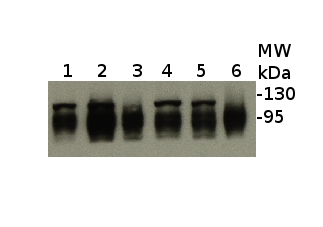
10 µg of total protein from 7 day old Arabidopsis plants grown at control conditions, 22°C wilde type, Columbia-9 (1), hot1-3, HSP101 null (2), clpBp-1, ClpBp null (3) and heat shocked at 38°C for 1.5 hour wilde type, Columbia-9 (4), hot1-3, HSP101 null (5), clpBp-1, ClpBp null (6) were separated on 7-16 % SDS-PAGE and blotted overnight to nitrocellulose membrane. Blots were blocked immediately following transfer in for 1h at room temperature with agitation. Blots were incubated in Agrisera anti-ClpB-P antibody (AS09 459) at a dilution of 1: 1000 for 1h at room temperature with agitation. The antibody solution was decanted and the blot was rinsed briefly twice, then washed once for 15 min and 3 times for 5 min in TBS-T at room temperature with agitation. Blots were incubated in secondary antibody (anti-rabbit IgG horse radish peroxidase conjugated) diluted to 1:2500 in 5% dry milk blocking solution for 1h at room temperature with agitation. The blots were washed as above and developed for 5 min with ECL detection reagent according to the manufacturers instructions. Exposure time was 20 seconds.
Courtesy Minsoo Kim, University of Arizona, USA
- Additional Information
-
Additional information: There is a cross-reacting band at ca. 95 kDa - therefore longer electrophoresis time is adviced to obtain good separation - Background
-
Background: ClpB-P is involved in chloroplast biogenesis. Synonymes: ALBINO AND PALE GREEN 6, APG6, AT5G15450, CASEIN LYTIC PROTEINASE B3, CASEIN LYTIC PROTEINASE B-P, CLPB3, CLPB-P, T20K14_60, T20K14.60
- Product Citations
-
Selected references: Jeran et al. (2021) The PUB4 E3 Ubiquitin Ligase Is Responsible for the Variegated Phenotype Observed upon Alteration of Chloroplast Protein Homeostasis in Arabidopsis Cotyledons. Genes (Basel). 2021 Sep 6;12(9):1387. doi: 10.3390/genes12091387. PMID: 34573369; PMCID: PMC8464772.
Tieu Ngoc et al. (2020). N4-methylcytidine ribosomal RNA methylation in chloroplasts is crucial for chloroplast function, development, and abscisic acid response in Arabidopsis. J Integr Plant Biol. 2020 Sep 2. doi: 10.1111/jipb.13009. Epub ahead of print. PMID: 32876986.
Han et al. (2015). A nuclear-encoded chloroplast-targeted S1 RNA-binding domain protein affects chloroplast rRNA processing and is crucial for the normal growth of Arabidopsis thaliana. Plant J. 2015 Jul;83(2):277-89. doi: 10.1111/tpj.12889. Epub 2015 Jun 15. - Protocols
-
Agrisera Western Blot protocol and video tutorials
Protocols to work with plant and algal protein extracts
Oxygenic photosynthesis poster by prof. Govindjee and Dr. Shevela
Z-scheme of photosynthetic electron transport by prof. Govindjee and Dr. Björn and Dr. Shevela - Reviews:
-
This product doesn't have any reviews.
Related products
AS09 602 | Clonality: Polyclonal | Host: Goat | Reactivity: Rabbit IgG (H&L)
AS09 607 | Clonality: Polyclonal Host: Goat Reactivity: Rabbit IgG (H&L)
AS13 2655 | Clonality: Polyclonal | Host: Rabbit | Reactivity: Arabidopsis thaliana