
1
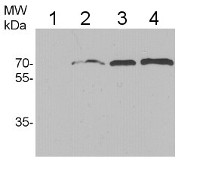
Anti-HSP70/HSC70 | Heat shock protein 70
AS09 592 | Clonality: Polyclonal | Host: Rabbit | Reactivity: Arabidopsis thaliana, Acanthamoeba castellanii (amoeba), Dictyostelium discoideum, frog-heart, frog-skeletal muscle, frog-liver, Caenorhabditis elegans, salmon (Salmo salar) , rainbow trout (Oncorhynchus mykiss), cow, chicken, pig, rat, seal, mummichog
- Product Info
-
Immunogen: KLH-conjugated C-terminal synthetic peptide conserved in hsc/hsp70 sequences from a wide range of animal species Host: Rabbit Clonality: Polyclonal Purity: Serum Format: Lyophilized Quantity: 200 µl Reconstitution: For reconstitution add 200 µl of sterile water Storage: Store lyophilized/reconstituted at -20°C; once reconstituted make aliquots to avoid repeated freeze-thaw cycles. Please remember to spin the tubes briefly prior to opening them to avoid any losses that might occur from material adhering to the cap or sides of the tube. Tested applications: Western blot (WB) Recommended dilution: 1 : 10 000 (WB) Expected | apparent MW: 70 kDa
- Reactivity
-
Confirmed reactivity: Arabidopsis thaliana, Acanthamoeba castellanii (amoeba), Caenorhabditis elegans, salmon (Salmo salar), Dictyostelium discoideum, frog-heart, Frog-skeletal muscle, Frog-liver, rainbow trout (Oncorhynchus mykiss), cow, Chicken, pig, Rat, seal, mummichog Predicted reactivity: Gammarus pulex, Salmo salar (Atlantic salmon), Salvelinus fontinalis (Brook trout)
Species of your interest not listed? Contact usNot reactive in: No confirmed exceptions from predicted reactivity are currently known - Application Examples
-
Application example
Dictyostelium discoideum (1), Acanthamoeba castellanii (2), Frog-heart (3), Frog-skeletal muscle (4), Frog-liver (5), Caenorhabditis elegans (6), Arabidopsis thaliana (7), tissues were homogenized in glass homogenizer in PBS buffer and centrifuged at 500 x g for 5 min. Supernatant was collected and 50 µg of protein for each gel lane was denatured with Laemmli buffer at 950C for 5 min. Samples were separated on 14 % SDS-PAGE and blotted 1h to nitrocellulose using semi-dry transfer. Blot was blocked overnight in 5% milk in TBS buffer and next incubated in the primary antibody at a dilution of 1: 2000 for 1h at RT with agitation. The antibody solution was decanted and the blot was washed once for 15 min and 4 times for 5 min in TBS-T at RT with agitation. Blot was incubated in secondary antibody (anti-rabbit IgG horse radish peroxidase conjugated, from ) diluted to 1:25000 for 1h at RT with agitation. The blot was washed as above and developed for 5 min with chemiluminescent detection. Exposure time was 300 seconds.
Courtesy Dr. Małgorzata Słocińska, UAM, Poland
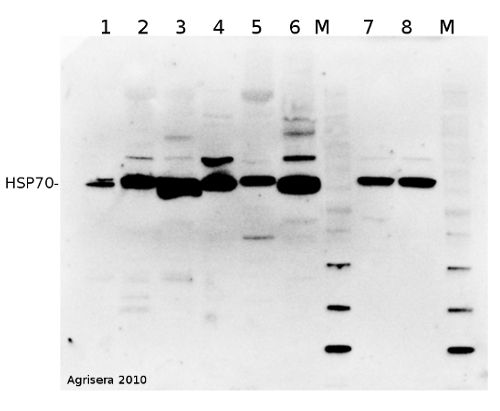
5 µg of total protein from (1) cow muscle, (2) chicken muscle, (3) pig muscle, (4) rat liver, (5) salmon muscle , (6) seal muscle, (7) mummichog heat shock control, (8) mummichog heat shock post-24 hours, extracted with Protein Extration Buffer, PEB (AS08 300), were separated on 4-12% NuPage (Invitrogen) LDS-PAGE and blotted 1h to PVDF. Blots were blocked immediately following transfer in 2% ECL Advance blocking reagent (GE Healthcare) in 20 mM Tris, 137 mM sodium chloride pH 7.6 with 0.1% (v/v) Tween-20 (TBS-T) for 1h at room temperature with agitation. Blots were incubated in the primary antibody at a dilution of 1: 10 000 for 1h at room temperature with agitation. The antibody solution was decanted and the blot was rinsed briefly twice, then washed once for 15 min and 3 times for 5 min in TBS-T at room temperature with agitation. Blots were incubated in secondary antibody (Agrisera anti-rabbit IgG horse radish peroxidase conjugated, AS09 602) diluted to 1:50 000 in 2% ECL Advance blocking solution for 1h at room temperature with agitation. The blots were washed as above and developed for 5 min with ECL Advance detection reagent according to the manufacturers instructions. Images of the blots were obtained using a CCD imager (FluorSMax, Bio-Rad) and Quantity One software (Bio-Rad). Exposure time was 30 seconds.
- Additional Information
-
Additional information: Chosen peptide sequence is also conserved in several fish species including: DQ202278.1 HSC70 Fundulus, DQ202279.1 HSP70-1 Fundulus, DQ202280.1 HSP70-2 Fundulus, BT059361.1 HSC70 Salmo salar (atlantic salmon), AB092839.2 HSP70 Carassius auratus (goldfish), BC056709.1 HSP70 Danio rerio (zebrafish) and other animal HSP70 proteins
- Background
-
Background: Heat-shock protein 70 (Hsp70) is the major stress-inducible protein in vertebrates and highly conserved throughout evolution. It plays a role as a molecular chaperone and is important for allowing cells to cope with acute stressor insult, especially those affecting the protein machinery. A killifish is a large family of various oviparous (egg-laying) cyprinodontiform fish including 1270 different species.
- Product Citations
-
Selected references: Peláez et al. (2025). Harnessing macroalgal cell walls to trigger immunity in Arabidopsis thaliana. Plant Stress Volume 15, March 2025, 100783.
Chandra et al. (2012). Sustained high temperature increases the vitellogenin response to 17 alpha-ethynylestradiol in mummichog (Fundulus heteroclitus). Aquatic toxicology. - Protocols
- Antibody protocols
- Reviews:
-
This product doesn't have any reviews.
Related products
AS09 602 | Clonality: Polyclonal | Host: Goat | Reactivity: Rabbit IgG (H&L)
AS09 607 | Clonality: Polyclonal Host: Goat Reactivity: Rabbit IgG (H&L)