
Visar bild 1 av
1
Anti-ROS1 | Repressor of silencing 1
Product no: AS24 5009
AS24 5009 | Clonality: Polyclonal | Host: Rabbit | Reactivity: Arabidopsis thaliana recombinant ROS1
230
€
Customer reviews
Delivery:
3-6 business days
- Product Info
-
Immunogen: KLH-conjugated peptide derived from Arabidopsis thaliana ROS1 protein sequence, UniProt: Q9SJQ6 , GeneID: AT2G36490 Host: Rabbit Clonality: Polyclonal Purity: Immunogen affinity purified serum, in PBS pH 7.4 Format: Lyophilized Quantity: 50 µg Reconstitution: For reconstitution, add 50 µl of sterile or deionized water. Storage: Store lyophilized/reconstituted at -20°C; once reconstituted make aliquots to avoid repeated freeze-thaw cycles. Please, remember to spin tubes briefly prior to opening them to avoid any losses that might occur from lyophilized material adhering to the cap or sides of the tubes. Tested applications: Western blot (WB) Recommended dilution: 1 : 1000 (WB) Expected | apparent MW: 156.7 kDa - Reactivity
-
Confirmed reactivity: Arabidopsis thaliana recombinant ROS1 - Additional Information
-
Additional information (application): ROS1 protein is of extremely low abundance, according to Protein Abundance Database, PAX. Therefore, to detect ROS1 in endogenous sample, high protein load of minimum 50 µg/well of nuclear fraction and extreme low femtogram detection range sensitivity of detection reagent must be applied. - Background
-
Background: ROS1 (Repressor of silencing 1) is a key bifunctional DNA glycosylase/lyase responsible for active DNA demethylation, which interacts with and is investigated alongside several key protein partners, complexes, and chromatin remodelers. Alternative names: DNA glycosylase/AP lyase ROS1, DEMETER-like protein 1.
- Protocols
-
Agrisera Western Blot protocol and video tutorials
Protocols to work with plant and algal protein extracts
Agrisera Educational Poster Collection - Reviews:
-
This product doesn't have any reviews.
Related products
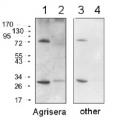
AS09 602 | Clonality: Polyclonal | Host: Goat | Reactivity: Rabbit IgG (H&L)
219 €
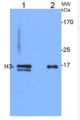
AS10 710 | Clonality: Polyclonal | Host: Rabbit | Reactivity: A. thaliana, B. cinerea, C.annuum, C. reinhardtii, G. hirsutum, H. vulgare, S. lycopersicum, V. faba, P. tricornutum, P. patens, S. europaea, Z. mays | cellular [compartment marker] of nucleoplasm
329 €