
1
Anti-PEPC 1 | Phosphoenolpyruvate carboxylase 1
AS16 4110 | Clonality: Polyclonal | Host: Rabbit | Reactivity: Sorghum bicolor
- Product Info
-
Immunogen: KLH-conjugated peptide derived from Arabidopsis thaliana PEPC1, UniProt: Q9MAH0, TAIR: AT1G53310 Host: Rabbit Clonality: Polyclonal Purity: Antigen affinity purified serum, in PBS pH 7.4 Format: Lyophilized Quantity: 50 ug Reconstitution: For reconstitution, add 50 µl of sterile water.
Storage: Lyophilized antibody can be stored at -20°C for up to 3 years. Re-constituted antibody can be stored at 4°C for several days to weeks.
Once reconstituted, make aliquots to avoid repeated freeze-thaw cycles. Please, remember to spin tubes briefly prior to opening them to avoid any losses that might occur from lyophilized material adhering to the cap or sides of the tubes.Tested applications: Western blot (WB) Recommended dilution: 1 : 1000 (WB)
Expected | apparent MW: 105 kDa
- Reactivity
-
Confirmed reactivity: Sorghum bicolor Predicted reactivity: Arabidopsis thaliana, Camelina sativa, Capsella rubella, Sorghum bicolor Not reactive in: Lycopersicum esculentum, Oryza sativa, Setaria sp. Starkeya novella, Zea mays - Application Examples
-
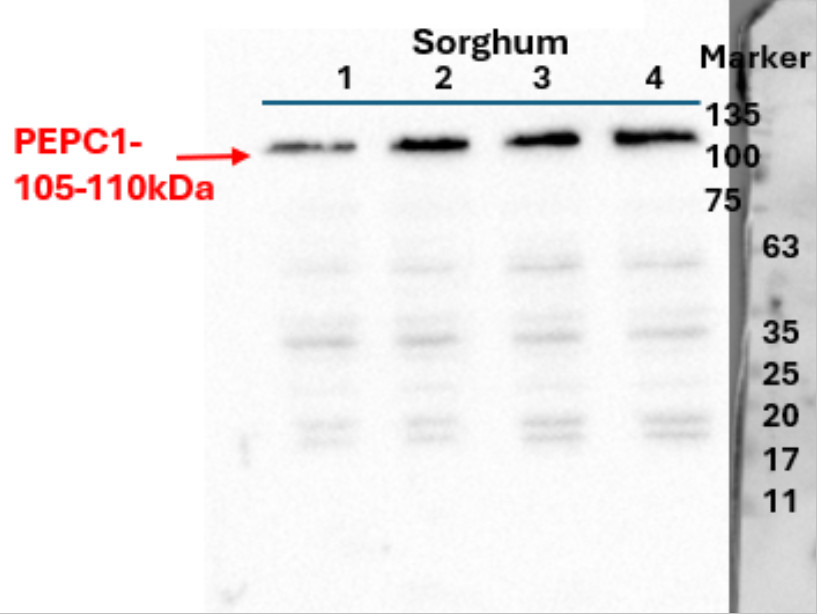
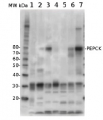
Samples: 1-4 20 ug of Sorghum bicolor wildtype leaves
Mark: MW markers
20 µg/well of total protein extracted freshly from Sorghum bicolor. Exact buffer components were: 80% Glycerol, 0.5M Tris-Hcl, p H 6.8, 10% SDS, 100% 2-mercaptoethanol and denatured with exact buffer components at 95 °C/ 10 min. Samples separated in the cold on 12.5 % SDS-PAGE and blotted for 1h to PVDF membrane, using: wet transfer in the cold. Blot was blocked with 5 % milk for: 1h/RT with agitation. The blot was incubated in the primary antibody at a dilution of 1: 1000 for overnight, 4°C with agitation. The antibody solution was decanted, and the blot was rinsed briefly twice, then washed once for 15 min and 3 times for 5 min in TBS-T at RT with agitation. Blot was incubated in matching secondary antibody (anti-rabbit IgG) diluted to 1: 10 000 in for 1h/RT with agitation. The blot was washed as above and developed with a following chemiluminescent detection reagent. Exposure time was 2 seconds. - Background
-
Background: Phosphoenolpyruvate carboxylase (PEPC; EC 4.1.1.31) serves as an important control element in the regulation of photosynthetic carbon metabolism in C4 and CAM plants. This is the first enzyme of the pathway, and PEPC enzymes are encoded by a small multigenic family. Several isoforms of PEPC have been characterised in maize, sorghum and sugarcane. These isoforms are involved in several functions such as the initial fixation of atmospheric CO2 (= C4 PEPC) and anaplerotic functions associated with nitrogen assimilation or amino acid biosynthesis (Lepiniec et al. 1994). - Product Citations
-
Selected references: 38221900 - Reviews:
-
Zhengsong Chen | 2026-01-09I can confirm reactivity against protein from Sorghum's PEPC1. The band is clear and there are no other disturbing bands at the same height.
Related products
AS09 602 | Clonality: Polyclonal | Host: Goat | Reactivity: Rabbit IgG (H&L)
AS09 458 | Clonality: Polyclonal | Host: Rabbit | Reactivity: A. comosus, A. thaliana, C. ciliaris, C. gayana, C. velia, Ch. quinoa, H. vulgare, J. curcas, K. prostrata, L. fusca, Lupinus sp. , M. maximus, M. crystallinum, N. tabacum, O. sativa, P. antidotale, P. coloratum, P. strobus, Saccharum spp. hybrid clone C91-301, S. lanata, S. laricifolia, S. bicolor, Synechocystis PCC 6803, Phaeodactylum tricornutum (strain CCAP 1055/1), T. weissfloggi, Z. mays, Z. muelleri
Benefits of using this antibody
AS07 241 | Clonality: Polyclonal | Host: Rabbit | Reactivity: [global antibody] for plants Ananas comosus, Miscantus giganteus, Mouse, Nannochloropsis oceanica, Oryza sativa, Panicum maximum,, Panicum virgatum, Phaseolus vulgaris, Saccharum spp. hybrid clone C91-301, Spartina alterniflora, Spartina patens, Zea mays
Benefits of using this antibody
AS03 037 | Clonality: Polyclonal | Host: Rabbit | Reactivity: global antibody and compartment marker for higher plants, lichens, algae, cyanobacteria, dinoflagellates, diatoms
Benefits of using this antibody