
1
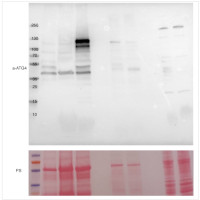
Anti-ATG4 | Autophagy protein 4 isoform (plant)
AS24 5057 | Clonality: Polyclonal | Host: Rabbit | Reactivity: Arabidopsis thaliana
- Product Info
-
Immunogen: Part of recombinant ATG4 protein of Arabidopsis thaliana
ATG4a UniProt: Q8S929 GeneID: At2g44140 and ATG4b UniProt: Q9M1Y0 GeneID: AT3G59950Host: Rabbit Clonality: Polyclonal Purity: Antigen affinity purified serum, in PBS pH 7.4 Format: Lyophilized Quantity: 50 µg Reconstitution: For reconstitution, add 50 µl of sterile or deionized water. Storage: Store lyophilized/reconstituted at -20°C; once reconstituted make aliquots to avoid repeated freeze-thaw cycles. Please, remember to spin tubes briefly prior to opening them to avoid any losses that might occur from lyophilized material adhering to the cap or sides of the tubes. Tested applications: Western blot (WB) Recommended dilution: 1 : 1500 (WB) Expected | apparent MW: 52.5 kDa, 51 kDa - Reactivity
-
Confirmed reactivity: Arabidopsis thaliana Predicted reactivity: Brassica napus, Hordeum vulgare, Nicotiana tabacum, Oryza sativa, Pisum sativum, Solanum lycopresicum, Solanum tuberosum, Pisum sativum, Zea mays
Species of your interest not listed? Contact usNot reactive in: Chlamydomonas reinhardtii, Physcomitrium patens - Application Examples
-
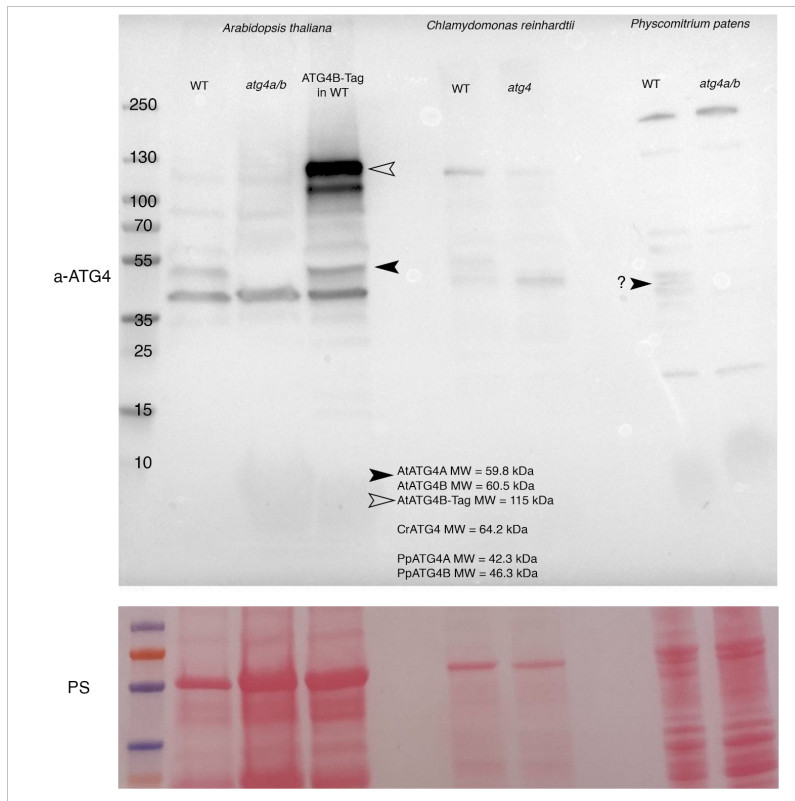
MW of ATG4 in analysed samples:
AtATG4A MW = 59.8 kDa (Arabidopsis thaliana)
AtATG4B MW = 60.5 kDa (Arabidopsis thaliana)
AtATG4B-Tag MW = 115 kDa (Arabidopsis thaliana)
CrATG4 MW = 64.2 kDa (Chlamydomonas reinhardtii) negative control
PpATG4A MW = 42.3 kDa (Physcomitrium patens) negative control
PpATG4B MW = 46.3 kDa (Physcomitrium patens) negative control20-50 µg/well of total protein extracted freshly from true leaves of 4-week-old A. thaliana plants. Used backgrounds were wild type Col-0, atg4a-2/b-2 (Zou et al, 2025.Nat Comms. https://doi.org/10.1038/) and wild-type over-expressing tagged ATG4B (recently established in my group, not published).
10 ug/well of total protein extracted from whole cells of Chlamydomonas reinhardtii at the log phase of growth. Wild-type and atg4KO lines were used for protein extraction (Zou et al, 2025.Nat Comms. https://doi.org/10.1038/)
20 ug/well of total protein freshly extracted from leafy tissue of Physcomitrium patens of the wild-type and atg4a/b knockout backgrounds (recently established in my group, not published). Plant material was flash frozen in liquid N2, powdered and mixed 1:1 with 2xLaemmli buffer. Samples were boiled at 90 °C for 5 minutes, spund down at 17000g for 5 minutes-> supernatants were stored at -20 °C at preheated at 95 °C for 1 minute before loading on the gel Samples were separated in the cold on precast TGX, StainFree Bio-Rad 4-20% SDS-PAGE and blotted for 7.5 minutes to PVDF using Bio-Rad premade cassettes and Turbo program for semi-dry transfer. Blot was blocked with 5% milk for 15 minutes at RT with agitation. Blot was incubated in the primary antibody at a dilution of 1:500 for 48h at 4 °C. The antibody solution was decanted, and the blot was washed four times for 10 minutes in PBS-T at RT with agitation. Blot was incubated in a-rabbit HRP secondary antibody (AS09 602-trial Goat anti-rabbit HRP conjugated) diluted to 1: 50 000 in 2.5% skim milk for 1 h/RT with agitation. The blot was washed as above and developed with a following chemiluminescent detection reagent: ECL, Bio-Rad. Exposure time was collected in accumulation mode, every second for the period of 100 seconds. After luminescence detection, the membrane was stained with Ponceau S for loading control.Note: Shorter incubation time with ATG4 antibody will decrease background signal.
Courtesy of Dr. Dr. Alyona Minina, Swedish University of Agricultural Sciences, Sweden
- Protocols
-
Agrisera Western Blot protocol and video tutorials
Protocols to work with plant and algal protein extracts
Agrisera Educational Poster Collection - Reviews:
-
This product doesn't have any reviews.
Related products
AS09 602 | Clonality: Polyclonal | Host: Goat | Reactivity: Rabbit IgG (H&L)
AS15 2831 | Clonality: Polyclonal | Host: Rabbit | Reactivity: Chlamydomonas reinhardtii, Chlorococcum dorsiventrale
AS14 2769 | Clonality: Polyclonal | Host: Rabbit | Reactivity: Arabidopsis thaliana, Aponogeton madagascariensis, Chlamydononas reinhardtii, Chlorococcum dorsiventrale, Gossypim hirsutum, Haematococcus lacustris, Lupinus albus, Lupinus mutabilis, Malus domesticus, Nicotiana benthamiana, Populus trichocarpa, Solanum lycopersicum, Zea mays
AS16 4072 | Clonality: Polyclonal | Host: Rabbit | Reactivity: Arabidopsis thaliana