
1
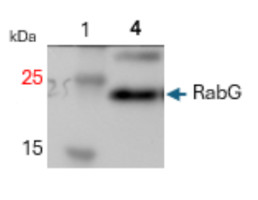
Anti-RabG | Ras-related protein RABG (global antibody)
AS23 4986 | Clonality: Polyclonal | Host: Rabbit | Reactivity: Arabidopsis thaliana
- Product Info
-
Immunogen: KLH-conjugated peptide derived from Arabidopsis thaliana RabG, UniProt: Q9LS94 TAIR: AT3G18820. The peptide used to elicit this antibody is conserved in the products of the following isoforms: AT1G22740.1, AT1G52280.1, AT1G49300.2, AT1G49300.1, AT3G16100.1, AT2G21880.2, AT2G21880.1, AT4G09720.3, AT4G09720.4, AT4G09720.1, AT2G21880.4, AT2G21880.3, AT4G09720.6, AT4G09720.5, AT4G09720.2 Host: Rabbit Clonality: Polyclonal Purity: Antigen affinity purified serum, in PBS pH 7.4 Format: Lyophilized Quantity: 50 µg Reconstitution: For reconstitution, add 50 µl of sterile or deionized water. Storage: Store lyophilized/reconstituted at -20°C; once reconstituted make aliquots to avoid repeated freeze-thaw cycles. Please, remember to spin tubes briefly prior to opening them to avoid any losses that might occur from lyophilized material adhering to the cap or sides of the tubes. Tested applications: Western blot (WB) Recommended dilution: 1 : 1000 (WB) Expected | apparent MW: Approx. 23 kDa (due different paralogs) - Reactivity
-
Confirmed reactivity: Arabidopsis thaliana Predicted reactivity: Arachis hypogaea, Brachypodium distachyon, Brassica napus, Cannabis sativa, Capsicum annuum, Citrus sp., Cucumis sativus, Glycine max, Gossypium sp., Hordeum vulgare, Malus domestica, Manihot esculenta, Medicago truncatula, Nicotiana tabacum, Oryza sativa, Pisum sativum, Populus sp., Solanum lycopersicum, Solanum tuberosum, Sorghum bicolor, Theobroma cacao, Triticum sp., Vitis vinifera, Zea mays
Species of your interest not listed? Contact usNot reactive in: No confirmed exceptions from predicted reactivity are currently known - Application Examples
-
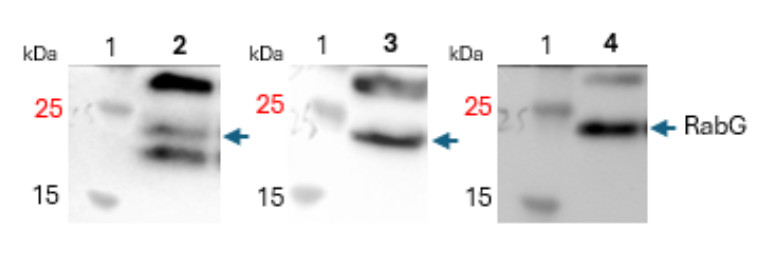
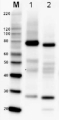
Samples:
1 - MW Marker
2 - Arabidopsis thaliana wild type (Col-0) – cytoplasm
3 - Arabidopsis thaliana wild type (Col-0) – Inner membrane
4 - Arabidopsis thaliana wild type (Col-0) – Plasma membrane
Protein extracted freshly, from Wild Type (Col-0) Arabidopsis thaliana and mixed with 2x Laemmli sample buffer plus beta-mercaptoethanol and denatured at 95 °C for 5 min prior to SDS-PAGE analysis. Samples were separated on 4-20% SDS-PAGE at room temperature and blotted for 7 min to nitrocellulose Membrane (pore size of 0.2 µm), using: semi-wet transfer system. Blot was blocked with 1x TBS 1% Casein Blocker for 1h/RT. Blot was incubated in the primary antibody at a dilution of 1: 500 for ON/4°C with agitation. The antibody solution was decanted, then washed 3 times for 5 min in TBS-T at RT. Blot was incubated in matching secondary antibody (anti-rabbit IgG horse radish peroxidase conjugated) diluted to 1: 25k for 3h/RT with agitation. The blot was washed as above and developed with a following chemiluminescent detection reagent: SuperSignal West Pico Plus chemiluminescent ThermoScientific). Exposure time was a few seconds to 1 minutes.
Courtesy of Sahar Farami, University of Glasgow, UK
- Background
-
Background: RabG (Ras-related protein RABG) is essential for trafficking from prevacuolar compartments to vacuoles. Involved in the trafficking of newly synthesized protein to vacuoles. Essential for plant growth and participates in the recruitment of the core retromer components to the endosomal membrane by interacting with VPS35A. Alternative names: Ras-related protein Rab71 (AtRab71), Ras-related protein Rab7B (AtRab7B)
- Protocols
-
Agrisera Western Blot protocol and video tutorials
Protocols to work with plant and algal protein extracts
Agrisera Educational Poster Collection - Reviews:
-
This product doesn't have any reviews.
Related products
AS09 602 | Clonality: Polyclonal | Host: Goat | Reactivity: Rabbit IgG (H&L)
AS23 4967 | Clonality: Polyclonal | Host: Rabbit | Reactivity: Arabidopsis thaliana
AS09 481 | Clonality: Polyclonal | Host: Rabbit | Reactivity: A. thaliana, B. napus, Chara australis, C. reinhardtii, C. sativus, M. perniciosa, N. benthamiana, N. tabacum, R. sativa, L.Tokinashi-daikon, O. europaea, O. sativa, P. abies, P. patens, S. oleracea, S. lycopersicum, S. tuberosum, T. aestivum, Z. mays
AS10 690 | Clonality: Polyclonal | Host: Rabbit | Reactivity: Arabidopis thaliana, Chlamydomonas reinhardtii, Nicotiana tabacum