
1
Anti-HSP90 | Heat shock protein 90 (cytoplasmic, monocot)
AS24 5049 | Clonality: Polyclonal | Host: Rabbit | Reactivity: Musa paradisica, Oryza sativa
- Product Info
-
Immunogen: KLH-conjugated peptide derived from monocotyl HSP90 protein sequences including Oryza sativa, UniProt: Q0J4P2 Host: Rabbit Clonality: Polyclonal Purity: Antigen affinity purified serum, in PBS pH 7.4 Format: Lyophilized Quantity: 50 µg Reconstitution: For reconstitution, add 50 µl of sterile or deionized water. Storage: Store lyophilized/reconstituted at -20°C; once reconstituted make aliquots to avoid repeated freeze-thaw cycles. Please, remember to spin tubes briefly prior to opening them to avoid any losses that might occur from lyophilized material adhering to the cap or sides of the tubes. Tested applications: Western blot (WB) Recommended dilution: 1 : 5000 (WB) Expected | apparent MW: 90 kDa - Reactivity
-
Confirmed reactivity: Musa paradisiaca, Oryza sativa Predicted reactivity: Hordeum vulgare, Triticum aestivum
Species of your interest not listed? Contact usNot reactive in: No confirmed exceptions from predicted reactivity are currently known - Application Examples
-
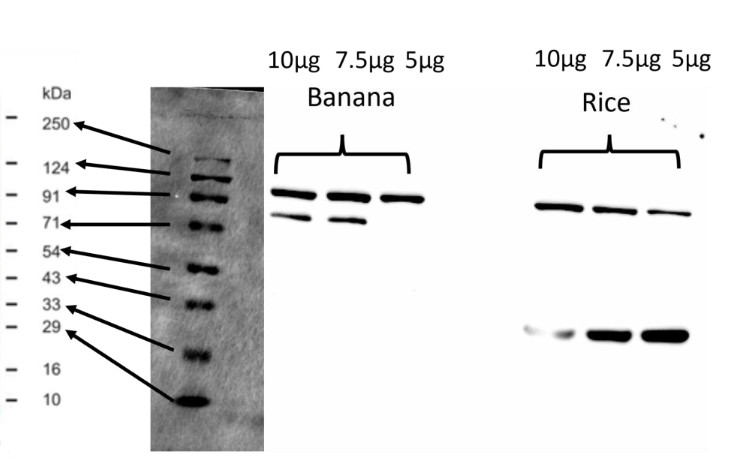
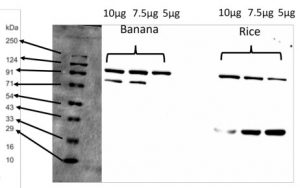
15-25 μg/well for rice and 5-10 μg/well for banana of total protein was extracted freshly from leaf sample (rice leaf taken from field; banana leaf taken from soil pot). Exact buffer components were 50mM Tris-Cl (ph 7.5), 150 mM NaCl, 10 mM MgCl2, 1 mM EDTA (pH 8.0), 10% Glycerol 0.1% Nonidet P40, 14 mM 2-betamercaptoethanol, 1X protein inhibitor cocktail, 40 μM MG132, and denatured at 95 °C for 10 min. Samples were separated in the RT at 10% SDS-PAGE and blotted for 3 h at 4°C at 300mA to nitrocellulose (pore size of 0.45 um), using wet transfer in the cold. Blot was blocked with 5% BSA for 2h/RT with agitation. Blot was incubated in the primary antibody at a dilution of 1: 5000 with agitation in PBS-T for ON/4°C. The antibody solution was decanted and the blot was washed once for 15 min and 3 times for 5 min in PBS-T at RT with agitation. Blot was incubated in matching secondary antibody (anti-rabbit IgG horse radish peroxidase conjugated) diluted to 1: 10 000 in for 2h/RT with agitation. The blot was washed as above and developed with a following chemiluminescent detection reagent. Exposure time was 2 minutes.
Courtesy of Dr. Jogindra Naik, Plant Metabolic Engineering Group National Institute of Plant Genome Research, New Delhi, India
- Background
-
Background: HSP90 (Heat shock protein 90) acts as a crucial molecular chaperone, maintaining cellular homeostasis by facilitating the folding, maturation, and stability of client proteins involved in signal transduction, development, and stress responses. In monocots, HSP90 is essential for adapting to environmental stressors like heat, regulating photosynthetic machinery (e.g., in plastids), and, together with co-chaperones like RAR1 and SGT1, managing plant disease resistance. - Protocols
-
Agrisera Western Blot protocol and video tutorials
Protocols to work with plant and algal protein extracts
Agrisera Educational Poster Collection - Reviews:
-
This product doesn't have any reviews.
Related products
AS09 602 | Clonality: Polyclonal | Host: Goat | Reactivity: Rabbit IgG (H&L)
AS07 253 | Clonality: Polyclonal | Host: Rabbit | Reactivity: A.thaliana, A. tequilana var. Weber,B. oleracea, N. tabacum, O. sativa, S. lycopersicum, T. aestivum, T. salsuginea, V.faba
AS08 348 | Clonality: Polyclonal | Host: Rabbit | Reactivity: A. thaliana, H. vulgare, O. sativa, P. sativm, P. strobus
AS08 347 | Clonality: Polyclonal | Host: Rabbit | Reactivity: Arabidopsis thalian, Brassica oleracea, Hordeum vulagre