
1
Anti-HY5 | Protein long hypocotyl 5 (other species)
AS23 4905 | Clonality: Polyclonal | Host: Rabbit | Reactivity: Ocimum basilicum, Solanum lycopersicum
- Product Info
-
Immunogen: KLH-conjugated peptide derived from known HY5 protein sequences of higher plants, including A0A1D6H3I5 Host: Rabbit Clonality: Polyclonal Purity: Immunogen affinity purified serum, in PBS pH 7.4 Format: Lyophilized Quantity: 50 µg Reconstitution: For reconstitution add 50 µl, of sterile or deionized water. Storage: Store lyophilized/reconstituted at -20°C; once reconstituted make aliquots to avoid repeated freeze-thaw cycles. Please, remember to spin tubes briefly prior to opening them to avoid any losses that might occur from lyophilized material adhering to the cap or sides of the tubes. Tested applications: Western blot (WB) Recommended dilution: 1 : 1000 (WB) Expected | apparent MW: 19.8 kDa - Reactivity
-
Confirmed reactivity: Ocimum basilicum, Solanum lycopersicum Predicted reactivity: Artemisia annua, Daucus carota, Gossypium hirsutum, Hordeum vulgare, Lactuca sativa, lotus japonicus, Marchantia polymorpha, Nicotiana tabacum, Physcomitrium patens, Rosa chinensis, Solanum lycopersicum, Triticum aestivum, Vitis vinifera, Zea mays
Species of your interest not listed? Contact usNot reactive in: No confirmed exceptions from predicted reactivity are currently known - Application Examples
-
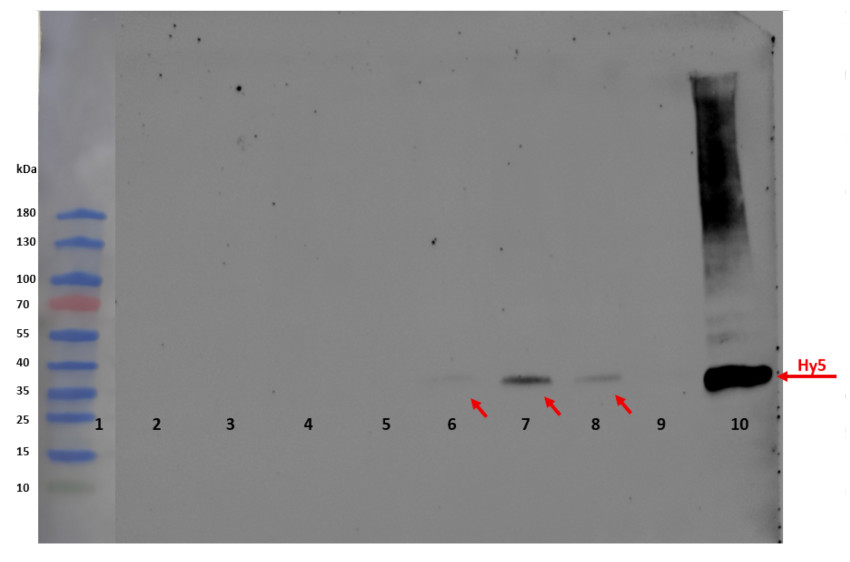
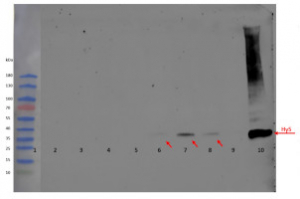
Samples:
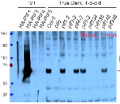
1 - marker MW: PageRuler™ Prestained Protein Ladder, 10 to 180 kDa (5 µl)
2 - 20 µg of Lactuca sativa var. crispa L. cv. Lollo Rossa whole leaf extract (leaf) – control (RGB* light)
3 - 20 µg of Lactuca sativa var. crispa L. cv. Lollo Rossa whole leaf extract (leaf) – (RGB light + UVA*)
4 - 20 µg of Lactuca sativa var. crispa L. cv. Lollo Rossa whole leaf extract (leaf) – (RGB light + UVB*)
5 - 20 µg of Lactuca sativa var. crispa L. cv. Lollo Rossa whole leaf extract (leaf) – (RGB light + UVC*)
6 - 40 µg of Ocimum basilicum L. cv. Sweet Large whole leaf extract (leaf) – control (RGB light)
7 - 40 µg of Ocimum basilicum L. cv. Sweet Large whole leaf extract (leaf) – control (RGB light + UVA)
8 - 40 µg of Ocimum basilicum L. cv. Sweet Large whole leaf extract (leaf) – control (RGB light + UVB)
9 - 40 µg of Ocimum basilicum L. cv. Sweet Large whole leaf extract (leaf) – control (RGB light + UVC)
10 - 60 µg of Solanum lycopersicum L.cv. Blackball whole leaf extract (leaf) – control (RGB light)Leaf tissue from plant species listed above was ground in a cold mortar with a pestle (on ice) in extraction buffer (500 µl of buffer per 100 mg of fresh leaf tissue). The extraction buffer (alkaline lysis buffer, according to Tsugarna et al. 2011) consisted of 0.1 M NaOH, 0.05 M EDTA, 2% SDS, and 2% β-mercaptoethanol. The homogenate was incubated at 90°C for 10 min with shaking (1500 rpm, Eppendorf® ThermoMixer®), then cooled to RT, and 5 µl of 4 M acetic acid was added to each tube to neutralize the pH. The samples were again incubated at 90°C for 10 min with shaking. Samples, after total protein estimation (NanoDrop), were mixed with 2x Laemmli Sample Buffer (Bio-Rad) (20 µl of sample and 20 µl of buffer) and separated on a 4–20% SDS-PAGE gel (50 µl well volume; Mini-PROTEAN® TGX™ Precast Gels, Bio-Rad) for 25 min at 200 V using 1× Tris/Glycine/SDS running buffer, with PageRuler™ Prestained Protein Ladder (10-180 kDa; 5 µl). Proteins separated on the gel were transferred for 7 min (semi-dry, Trans-Blot Turbo system) onto a nitrocellulose membrane (0.2 µm pore size, Bio-Rad) using Trans-Blot Turbo Transfer Buffer (Bio-Rad). After transfer, the blot was air-dried for 30 min and blocked with 5% non-fat milk in TTBS (TBS buffer, H₂Od, Tween 20; Bio-Rad) for 1 h at RT with gentle agitation. The blot was then incubated with the primary antibody at a dilution of 1:1000 (in TTBS) for 1 h at RT and subsequently overnight at 4°C with gentle agitation (primary antibody: Agrisera, AS23 4905). The next day, the antibody solution was decanted, and the blot was rinsed and washed 3 × 5 min at RT with gentle agitation (in TTBS). The blot was incubated with a matching secondary antibody (anti-rabbit IgG horseradish peroxidase-conjugated, Agrisera AS09 602) diluted 1:10 000 (in TTBS) for 1 h at RT with gentle agitation. The blot was washed as above (3 × 5 min at RT in TTBS) and developed using the chemiluminescent detection chemiluminescent detectionreagent of low femtogram detection range. Exposure time was 2 min. Detection was performed using a ChemiDoc System (Bio-Rad).
Note: the level of HY5 protein is correlated with RGB light, especially UV-A and UV-B which are known to activate photomorphogenesis, observed in samples7 and 8, respectively. Exposure of plants with UV-C leads to HY5 protein degradation, observed in sample 9.Courtesy of Ernest Skowron, phd, Division of Environmental Biology Institute of Biology Jan Kochanowski University, Poland
- Background
-
Background: HY5 (Protein long hypocotyl 5) is a light-regulated transcription factor that promotes photomorphogenesis in light. Involved in the blue light specific pathway. Heterodimer. Expressed in root, hypocotyl, cotyledon, leaf, stem and floral organs. Localized in nucleus. - Protocols
-
Agrisera Western Blot protocol and video tutorials
Protocols to work with plant and algal protein extracts
Agrisera Educational Poster Collection - Reviews:
-
This product doesn't have any reviews.
Related products
AS09 602 | Clonality: Polyclonal | Host: Goat | Reactivity: Rabbit IgG (H&L)
AS20 4399 | Clonality: Polyclonal | Host: Rabbit | Reactivity: Arabidopsis thaliana
AS16 3954 | Clonality: Polyclonal | Host: Goat | Reactivity: Arabidopsis thaliana
AS12 1867 | Clonality: Polyclonal | Host: Rabbit | Reactivity: Arabidopsis thaliana