
1
Anti-P2K1| L-type lectin-domain containing receptor kinase I.9
AS22 4826 | Clonality: Polyclonal | Host: Rabbit | Reactivity: Arabidopsis thaliana recombinant P2K1
- Product Info
-
Immunogen: KLH-conjugated peptide derived from Arabidopsis thaliana DORN1 protein, UniProt: Q9LSR8-1, TAIR: AT5G60300 Host: Rabbit Clonality: Polyclonal Purity: Immonogen affinity purified serum, in PBS pH 7.4 Format: Lyophilized Quantity: 50 µg Reconstitution: For reconstitution add 50 µl, of sterile or deionized water. Storage: Store lyophilized/reconstituted at -20°C; once reconstituted make aliquots to avoid repeated freeze-thaw cycles. Please, remember to spin tubes briefly prior to opening them to avoid any losses that might occur from lyophilized material adhering to the cap or sides of the tubes. Tested applications: Western blot (WB) Recommended dilution: 1 : 1000 (WB) Expected | apparent MW: 85 | 100-110 kDa (due to heavy glycosylation) - Reactivity
-
Confirmed reactivity: Arabidopsis thaliana recombinant P2K1 Not reactive in: Musa paradisiaca, Piper sp., Zingiber officinale - Application Examples
-
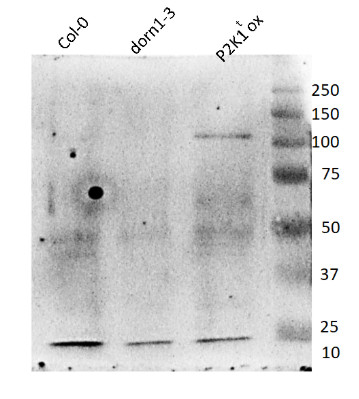
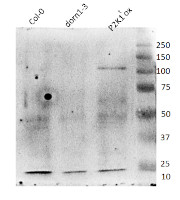
Samples:
Col-0 - Arabidopsis thaliana WT
dorn1-3 - Arabidopsis thaliana mutant
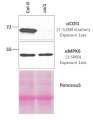
P2k1ox - Arabidopsis thaliana overexpressing line15-20 µg/well of total protein extracted freshly from Arabidopsis thaliana microsomes. The exact buffer components were: 50 mM Hepes, pH 7.5, 250 mM sucrose, 15 mM EDTA, 5% glycerol, 1 mM DTT, and 1X HALT protease/phosphatase inhibitors. Protein concentration was measured using Bio-Rad Protein Assay Dye (cat # 5000006). SDS-PAGE samples were prepared by mixing 30 µL of protein extract with 10 µL 4x Laemmli buffer (0.25 M Tris HCl, pH 6.8, 8% SDS, 40% glycerol, 20% beta-mercaptoethanol, bromphenol blue) and heating at 95ºC for 5 min. SDS-PAGE and WB were performed and only low-molecular weight bands were visualized. Therefore, 20 µl of the prepared earlier SDS-PAGE samples were mixed with 30 µl of 2x Laemmli buffer with 8 M urea (8 M urea, 0.125 M Tris HCl, pH 6.8, 4% SDS, 20% glycerol, 10% beta-mercaptoethanol, bromphenol blue), so, the final urea concentration in the samples was 5.3 M. The samples were heated at 95ºC for 5 min, and SDS-PAGE was performed using 10 % acrylamide gel containing 8 M urea following blotting for 1.5 hrs to PVDF membrane (Immune-Blot PVDF Membranes for Protein Blotting, Bio-Rad, cat # 1620177, pore size of 0.2 µL), using wet transfer in the cold transfer buffer. The blot was blocked with 5 % dry non-fat milk for 1h/RT with agitation. The blot was incubated in the primary antibody at a 1: 1000 dilution ON/4°C with agitation. The antibody solution was decanted, and the blot was rinsed briefly twice, then washed once for 15 min and 3 times for 5 min in TBS-T at RT with agitation. The blot was incubated in a matching secondary antibody (anti-rabbit IgG horse radish peroxidase conjugated) diluted to 1: 25 000 in TBS-T for 1 h/RT with agitation. The blot was washed as above and developed with the extremely low femtogram detection range chemiluminescent reagent. Exposure time was from 10 seconds to 1 minute.
Courtesy of Natalia Moroz (Research Associate) at Washington State University), USA - Additional Information
-
Additional information (application): P2K1 protein is of low abundance, according to Protein Abundance Database, PAX. Therefore, to detect P2K1 in endogenous sample, high protein load of minimum 50 µg/well of membrane fraction and extreme low femtogram detection range sensitivity of detection reagent must be applied. - Background
-
Background: P2K1 (L-type lectin-domain containing receptor kinase I.9) is an essential receptor for extracellular ATP. It binds ATP with high affinity through its extracellular legume-lectin like region and is required for ATP-induced intracellular calcium response, mitogen-activated protein kinase 3 (MPK3) and MPK6 activation and ATP-induced gene expressio.
Alternative name: Protein DOES NOT RESPOND TO NUCLEOTIDES 1, Purinoreceptor kinase 1. - Protocols
-
Agrisera Western Blot protocol and video tutorials
Protocols to work with plant and algal protein extracts
Agrisera Educational Poster Collection - Reviews:
-
This product doesn't have any reviews.
Related products
AS09 602 | Clonality: Polyclonal | Host: Goat | Reactivity: Rabbit IgG (H&L)
AS15 2962 | Clonality: Polyclonal | Host: Rabbit | Reactivity: Arabidopsis thaliana, Solanum lycopersicum
AS12 2637 | Clonality: Polyclonal | Host: Rabbit | Reactivity: Arabidopsis thaliana
AS16 3688 | Clonality: Polyclonal | Host: Rabbit | Reactivity: Arabidopsis thaliana, Lupinus luteus