
| Quantitative Western blotting is a useful method in molecular biology and allows measuring the relative abundance of specific proteins in analyzed samples. The authors of the recent publication "Quantitative western blotting adapted for expanded sample capacity with non-linear curve fitting" Cheng et al. 2026, refined the method of multistrip Western blotting, which provides many advantages for handling of a large number of samples. Principle: multiple gels are trimmed, depending upon the size of a target protein to be visualized and transferred onto a single membrane Advantages: 13x3 sample sets can be analyzed on one membrane, which is handled in the same way. Authors show interesting data on how lack of SDS in transfer buffer can improve visualization of a target protein as well as documented an effect of tight assembly of sponge/gel/membrane on transfer efficiency. Four sponge layers provided uniform contact between gel and membranes, which is crucial for multistrip method. They also evaluated the advantages of non-linear and linear fitting using dilution series of protein extracts. To succeed with this method a plate-based transfer system is required as well as gentle agitation of the membranes with antibodies, as described by the authors. | 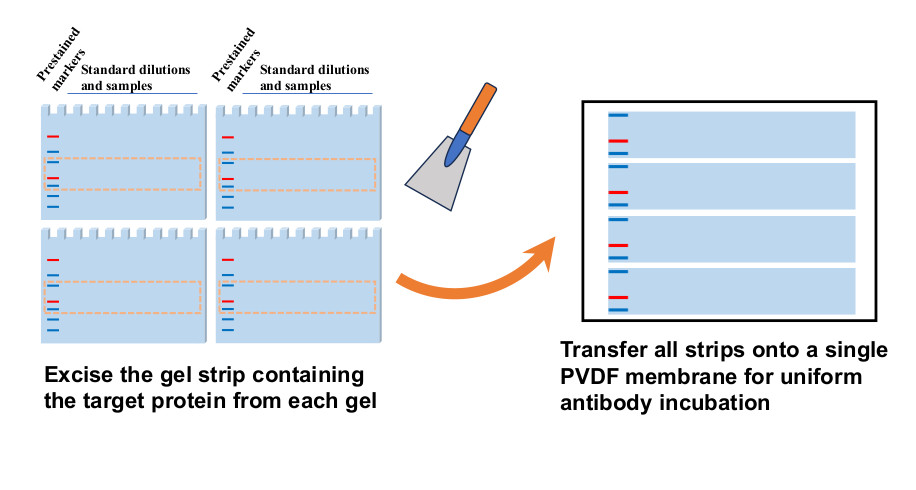 Illustration of part of steps in multistrip Western blot method. |
Technical tips
Latest
Where to find information about the exact epitope an antibody binds to2026-09-29 Quantitative Western blotting - multistrip method
2026-08-07 Are blocking conditions nothing to pay attention to?
2026-06-18 What are the most common misconceptions about primary antibodies?
2026-05-27 What are the most common mistakes done with secondary antibodies?
2026-05-26 Simple extraction protocol for membrane proteins
2026-04-17 How to improve signal with a weak antibody?
2026-03-26 Same antibody, different outcome on samples from wide taxonomic range
2026-02-23 Can the quality of protein transfer be checked before the blot is developed with antibodies?
2026-01-16 Is wild type a wild type?
2025-12-29
Archive
- September - 2026
- August - 2026
- June - 2026
- May - 2026
- April - 2026
- March - 2026
- February - 2026
- January - 2026
- December - 2025
- October - 2025
- September - 2025
- August - 2025
- July - 2025
- June - 2025
- May - 2025
- April - 2025
- March - 2025
- February - 2025
- January - 2025
- December - 2024
- November - 2024
- September - 2024
- July - 2024
- June - 2024
- May - 2024
- March - 2024
- February - 2024
- December - 2023
- November - 2023
- September - 2023
- July - 2023
- May - 2023
- March - 2023
- January - 2023
- December - 2022
- November - 2022
- October - 2022
- September - 2022
- August - 2022
- June - 2022
- May - 2022
- March - 2022
- February - 2022
- January - 2022
- November - 2021
- October - 2021
- August - 2021
- June - 2021
- May - 2021
- April - 2021
- March - 2021
- February - 2021
- January - 2021
- December - 2020
- November - 2020
- October - 2020
- September - 2020
- August - 2020
- July - 2020
- June - 2020
- May - 2020
- April - 2020
- March - 2020
- January - 2020
- November - 2019
- October - 2019
- March - 2019
- April - 2017
- February - 2017
- May - 2016
- February - 2014
- September - 2013
- December - 2010