
Visar bild 1 av
1
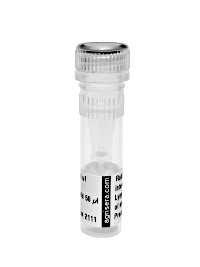
Anti-HSP21 | Chloroplastic heat shock protein
Product no: AS23 4982
AS23 4982 | Clonality: Polyclonal | Host: Rabbit | Reactivity: Arabidopsis thaliana
This antibody is a replacement of AS08 285.
329
€
Customer reviews
Delivery:
3-6 business days
- Product Info
-
Immunogen: KLH-conjugated peptide derived from the protein sequence of Arabidopsis thaliana HSP21, UniProt: P31170,GeneID: AT4G27670 Host: Rabbit Clonality: Polyclonal Purity: Antigen affinity purified serum, in PBS pH 7.4 Format: Lyophilized Quantity: 50 µg Reconstitution: For reconstitution, add 50 µl, of sterile or deionized water. Storage: Store lyophilized/reconstituted at -20°C; once reconstituted make aliquots to avoid repeated freeze-thaw cycles. Please, remember to spin tubes briefly prior to opening them to avoid any losses that might occur from lyophilized material adhering to the cap or sides of the tubes. Tested applications: Western blot (WB) Recommended dilution: 1 : 1000 (WB) Expected | apparent MW: 25 | 21 kDa (due to N-terminal or C-terminal processing) - Reactivity
-
Confirmed reactivity: Arabidopsis thaliana Predicted reactivity: Brassica napus, Hordeum vulgare, Nicotiana tabacum, Solanum tuberosum, Solanum lycopersicum
Species of your interest not listed? Contact usNot reactive in: Chlamydomonas reinhardtii - Background
-
Background: HSP21 is a chloroplast-localized small heat shock protein. The way small hsp proteins are protecting a living cell are not fully understood. They seem to be involved in chaperone functions by protecting other proteins from irreversible denaturation. Alternative name: 25.3 kDa heat shock protein, chloroplastic (AtHsp25.3)
- Protocols
-
Agrisera Western Blot protocol and video tutorials
Protocols to work with plant and algal protein extracts
Agrisera Educational Poster Collection - Reviews:
-
This product doesn't have any reviews.
Related products
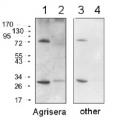
AS09 602 | Clonality: Polyclonal | Host: Goat | Reactivity: Rabbit IgG (H&L)
219 €
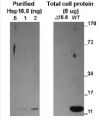
AS08 286 | Clonality: Polyclonal | Host: Rabbit | Reactivity: Synechocystis sp. PCC 6803
329 €
AS05 094A | Clonality: Polyclonal | Host: Rabbit | Reactivity: Arabidopsis thaliana
329 €
AS06 130 | Clonality: Polyclonal | Host: Rabbit | Reactivity: Arabidopsis thaliana
Note: Limited stock
428 €