
Glycine maxBelow you will find antibodies with confirmed or predicted reactivity to Glycine max Protocols and Technical Information • Support • Western Blot Video Tutorials |  |
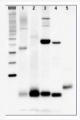
AS10 939 | Clonality: Polyclonal | Host: Rabbit | Reactivity: [global antibody] for higher plants, algae, cyanobacteria, diatoms
Benefits of using this antibody
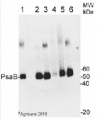
AS10 695 | Clonality: Polyclonal | Host: Rabbit | Reactivity: [global antibody] for higher plants, algae, cyanobacteria
Benefits of using this antibody

AS23 4978 | Clonality: Polyclonal | Host: Rabbit | Reactivity: Arabidopsis thaliana, Arachis hypogaea, Brassica napus, Glycine max, Gossypium sp., Medicago truncatula, Nicotiana tabacum, Pisum sativum, Populus sp., Solanum lycopersicum, Solanum tuberosum
Interested to receive a free sample for testing? Contact us.
Agrisera offers over 200 antibodies for free, in return for experimental results. Browse the complete list.
AS23 4979 | Clonality: Polyclonal | Host: Rabbit | Reactivity: Arabidopsis thaliana
Interested to receive a free sample for testing? Contact us.
Agrisera offers over 200 antibodies for free, in return for experimental results. Browse the complete list.
AS07 257-HRP | Clonality: Polyclonal | Host: Rabbit | Reactivity: A. thaliana, H. vulgare, Z. mays, cyanobacteria, diatoms
compartment marker of chloroplast stroma
compartment marker of chloroplast stroma
compartment marker of chloroplast stroma
compartment marker of chloroplast stroma
AS07 257B | Clonality: Polyclonal | Host: Rabbit | Reactivity: A. thaliana, H. vulgare, Z. mays, cyanobacteria, diatoms
compartment marker of chloroplast stroma
AS07 257-ALP | Clonality: Polyclonal | Host: Rabbit | Reactivity: A. thaliana, H. vulgare, Z. mays, cyanobacteria, diatoms
compartment marker of chloroplast stroma
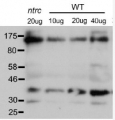
AS07 257 | Clonality: Polyclonal | Host: Rabbit | Reactivity: A. thaliana, H. vulgare, O. sativa, Z. mays, cyanobacteria, diatoms
compartment marker of chloroplast stroma
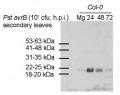
AS12 2369 | Clonality: Polyclonal | Host: Rabbit | Reactivity: Arabidopsis thaliana
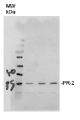
AS12 2366 | Clonality: Polyclonal | Host: Rabbit | Reactivity: Arabidopsis thaliana, Agostis stolonifera cv. ‘Penncross’, Glycine max
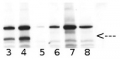
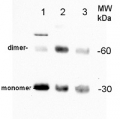
AS12 2110 | Clonality: Polyclonal | Host: Rabbit | Reactivity: L. sativa, P. sativum, S. lycopersicum, Z. mays
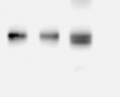
AS09 487 | Clonality: Polyclonal | Host: Rabbit | Reactivity: A. thaliana, J. curcas, P. nigra, P. trichocarpa, R. sativus
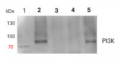
AS23 4959 | Clonality: Polyclonal | Host: Rabbit | Reactivity: Arabidopsis thaliana
Limited stock
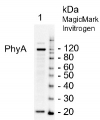
AS07 220 | Clonality: Polyclonal | Host: Rabbit | Reactivity: Arabidopsis thaliana, Nicotiana benthamiana, Nicotiana tabacum
AS15 3066 | Clonality: Polyclonal | Host: Rabbit | Reactivity: Zea mays
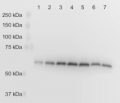
AS20 4391 | Clonality: Polyclonal | Host: Rabbit | Reactivity: Arabidopsis thaliana
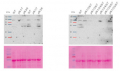
AS23 4914 | Clonality: Polyclonal |Host: Rabbit | Reactivity: Arabidopsis thaliana
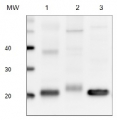
AS08 330 | Clonality: Polyclonal | Host: Rabbit | Reactivity: Arabidopsis thaliana, Brassica rapa subsp. chinensis, Chlamydomonas reinhardtii, Echinola crus-galli, Euglena sp., Haematococcus pluvialis, Nicotiana tabacum, Panicum miliaceum, Pisum sativum, Setaria viridis, Spinacia oleracea, Synechococcus PCC 7942, Synechocystis sp. PCC 6803, Thalassiosira guillardii, Zea mays
Benefits of using this antibody
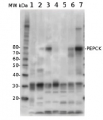
AS07 241 | Clonality: Polyclonal | Host: Rabbit | Reactivity: [global antibody] for plants Ananas comosus, Miscantus giganteus, Mouse, Nannochloropsis oceanica, Oryza sativa, Panicum maximum,, Panicum virgatum, Phaseolus vulgaris, Saccharum spp. hybrid clone C91-301, Spartina alterniflora, Spartina patens, Zea mays
Benefits of using this antibody
AS09 458-HRP | Clonality: Polyclonal | Host: Rabbit | Reactivity:A. comosus, A. thaliana, S. PCC 6803, Ch. velia, H. vulgare, J. curcas, Lupinus sp. , M. crystallinum, N. tabacum, O. sativa, Saccharum spp. hybrid clone C91-301, S. laricifolia, Z. mays, Synechocystis sp. , P. tricornutum (strain CCAP 1055/1), T. weissfloggi
Benefits of using this antibody
AS09 458B | Clonality: Polyclonal | Host: Rabbit | Reactivity:A. comosus, A. thaliana, S. PCC 6803, Ch. velia, H. vulgare, J. curcas, Lupinus sp. , M. crystallinum, N. tabacum, O. sativa, Saccharum spp. hybrid clone C91-301, S. laricifolia, Z. mays, Synechocystis sp. , P. tricornutum (strain CCAP 1055/1), T. weissfloggi
Benefits of using this antibody
AS09 458-ALP | Clonality: Polyclonal | Host: Rabbit | Reactivity:A. comosus, A. thaliana, S. PCC 6803, Ch. velia, H. vulgare, J. curcas, Lupinus sp. , M. crystallinum, N. tabacum, O. sativa, Saccharum spp. hybrid clone C91-301, S. laricifolia, Z. mays, Synechocystis sp. , P. tricornutum (strain CCAP 1055/1), T. weissfloggi
Benefits of using this antibody
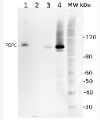
AS09 458 | Clonality: Polyclonal | Host: Rabbit | Reactivity: A. comosus, A. thaliana, C. ciliaris, C. gayana, C. velia, Ch. quinoa, H. vulgare, J. curcas, K. prostrata, L. fusca, Lupinus sp. , M. maximus, M. crystallinum, N. tabacum, O. sativa, P. antidotale, P. coloratum, P. strobus, Saccharum spp. hybrid clone C91-301, S. lanata, S. laricifolia, S. bicolor, Synechocystis PCC 6803, Phaeodactylum tricornutum (strain CCAP 1055/1), T. weissfloggi, Z. mays, Z. muelleri
Benefits of using this antibody