Agrisera News

Interview with Assoc. Prof. Sara Jover-Gil

Assoc. Prof Sara Jover-Gil

Sara

Dr. Sara Jover-Gil is an Associate Professor at Miguel Hernández University (UMH) in Spain, where she teaches genetics and researches plants using Arabidopsis thaliana as a model organism. Passionate about both plant biology and genetics, her research aims to uncover the molecular and genetic mechanisms that regulate plant development and adaptation, providing insights that are relevant for fundamental biology as well as addressing global challenges in agriculture and sustainability.


- Please tell us about yourself and your research/institution.

I completed my PhD in Plant Developmental Genetics, studying the roles of AGO1, HEN1, HYL1 and HST in leaf development in Arabidopsis thaliana at the Institute of Bioengineering (IB) of Miguel Hernandez University (UMH). Later, I decided to shift my research focus and model organism to pursue my postdoc at University of California at Berkeley and Lawrence Berkeley National Laboratory, where I did research on the genetic regulation of meiosis on Caenorhabditis elegans. This experience was both personally and professionally very fulfilling and has greatly influenced my current lines of research. In fact, the accumulated knowledge acquired on different topics and experimental model organisms both during my PhD and my postdoc contributed to successfully receive funding for a European International Reintegration Grant application, a Marie Curie action, which allowed me to return to Spain to continue my research career at the IB of UMH and start my teaching career too. I currently work as an Associate Professor at Miguel Hernandez University (UMH) in Spain, where I teach Genetics and conduct research on plant science, using Arabidopsis as a model plant.

My university, UMH, is a young one, since it was founded in 1996, in which approximately 20,000 students are enrolled. UMH is a multicampus university in which the 35 undergraduate degrees, the 51 Master studies and the 16 PhD programmes are distributed among 4 different campus locations, all in the province of Alicante, Spain. The main campus is located in Elche, and the other ones are in Sant Joan d’Alacant, Altea and Orihuela, which respectively include Health Sciences, Fine Arts and Agricultural degrees. UMH also encompasses 8 research institutes, including the IB.

Our research institute, the Institute of Bioengineering of UMH (https://bioingenieria.umh.es/en/), is an interdisciplinary center dedicated to improving life quality and health. It comprises 19 research groups distributed in 10 research units from several fields of knowledge, such as my field, Genetics, among others.


- What motivated you to get into plant science?

I have always thought the world of plant science is fascinating. I love plants and have always felt intrigued by the genetic mechanisms underlying their reproduction and development, since genetics is also my passion. Plants are essential for life, they are the foundation of the global food chain and the primary sources of oxygen, keeping our atmosphere healthy and clean. Therefore, I believe further research is critical to addressing the challenges facing the global population today, such as hunger and the increasing difficulty of sustaining traditional crops amidst climate change.

Model plants are easy to grow, and many tools have been developed to study them and do research. I think we should take advantage of all these tools to keep unveiling the different genes and mechanisms involved in their great capacity for adaptation to different environmental conditions, so that all that knowledge could be transferred to improve cultivated plants.

Furthermore, research conducted on plants involving genes and mechanisms conserved across eukaryotes contributes significantly to our broader understanding of other organisms.


- How have you used (Agrisera) antibodies in your research?

I have used antibodies to detect AGO1 in Western blot, as well as antibodies against cell cycle and meiotic proteins in immunofluorescence assays to start studying meiosis in Arabidopsis.


- Any further comments?

I am deeply grateful to Agrisera for their support to plant scientists through the development of high-quality plant-specific antibodies. I would like to especially thank Joanna; her technical support is exceptionally efficient and professional. She is always very helpful, kind and ready to resolve any technical issues or doubts that may arise. Her great expertise and enthusiasm of Joanna for assisting customers is truly remarkable. Furthermore, their webinars are highly educational and informative.

Finally, I deeply appreciate Agrisera is always to developing antibodies of interest to the plant science community, whereas most companies focus primarily on human or animal models. Their policy of offering free samples of new antibodies for testing across different techniques (such as Western blot and immunofluorescence) and various plant species is extremely convenient. This allows researchers to validate whether an antibody works for their specific species and experimental conditions. By sharing these results with other users, Agrisera helps the community save significant time and resources.


Links

• Assoc. Prof Sara Jover-Gil
• Agrisera Antibodies reactive in Arabidopsis thaliana
Read more 2026-02-23
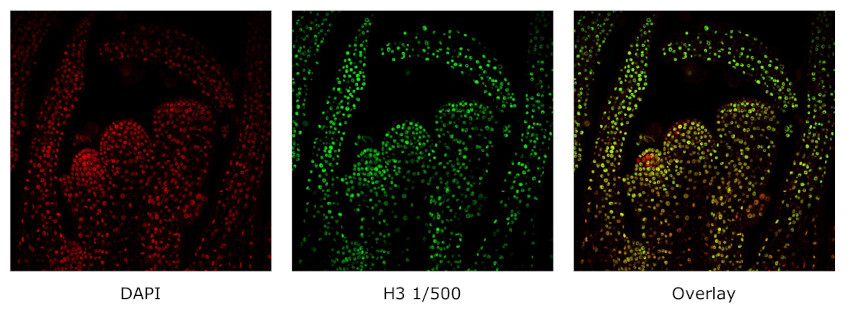
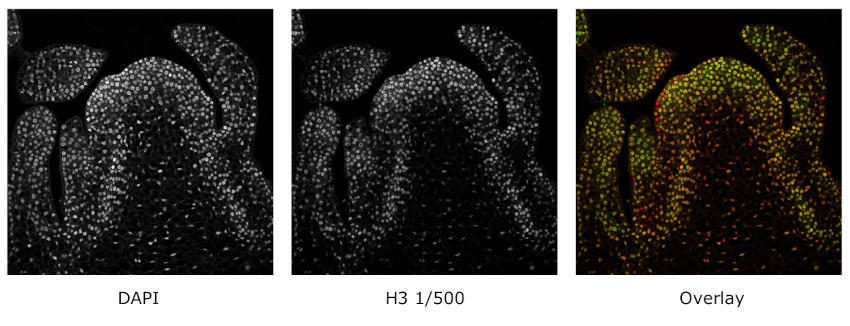
Immunofluorescent detection of plant histone 3


Fluorescent detection of plant histone 3

Bright, reliable fluorescent detection of plant Histone H3 using high-quality Agrisera polyclonal antibodies (antigen affinity purified). Validated for plant material, with detailed, application-specific protocola—including fixation methods—clearly described in the antibody product information sheet to support reproducible and high-confidence results.

Antibody: AS10 710A
Reactivity: wide taxonomic range
Applications: ChIp-qPCR (ChIp-qPCR), Immunofluorescence (IF), Western blot (WB)
 

Material: shoots of Arabidopsis thaliana
Immunofluorescent localization of histone 3 in Arabidopsis thaliana

Material: shoots of Cardamine hirsuta

Immunofluorescent localization of histone 3 in Cardamine hirsruta

Courtesy of Dr. Ton Timmers, Max Planck Institute for Plant Breeding Reseach, Cologne, Germany

Read more 2026-02-17

Agrisera supports the EpiseedLink conference


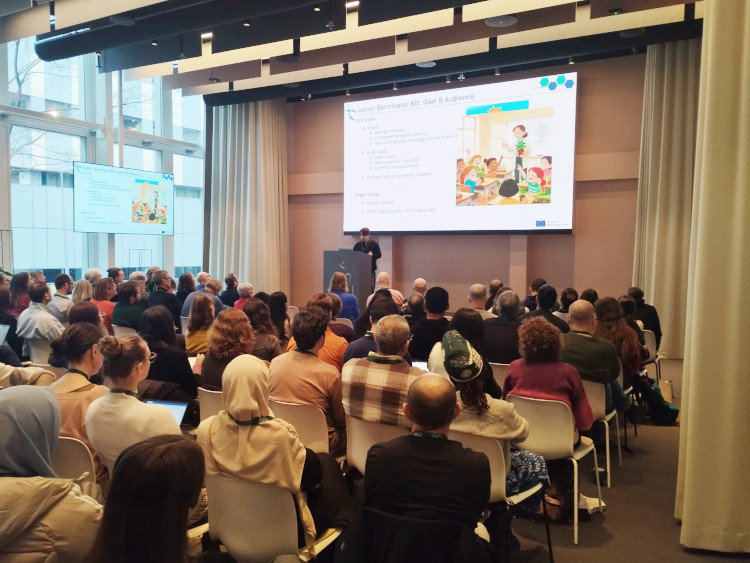
Agrisera supported the EpiSeedLink International conference 2026, which took place in Amsterdam, The Netherlands, between 9th-10th of February and gathered 150 attendees from all around the world. EpiSeedlink is a European research and training initiative focused on epigenetics and seed priming to improve crop performance under climate stress. The conference covered the following topics:
  • Seed biology and stress responses
  • Epigenetic mechanisms in plants
  • Translational research from Arabidopsis to crops
  • Diagnostic tools and biotechnological innovations for agriculture
The Agrisera Best Poster Prize was awarded to PhD candidate Nodoka Handa for the poster: "L3-interacting factors mediating epigenetic priming during shoot regeneration in Arabidopsis thaliana". Congratulations!

Agrisera was happy to support the meeting with educational posters focused on epigenetics as well as protein extraction and Western blot. 


Agrisera supports EpiSeedLink conference

Read more 2026-02-13

Interview with Prof. Stefan Jansson

Prof. Stefan Jansson

Stefan

Dr. Stefan Jansson is a Professor of Plant Molecular Cell Biology at UPSC, where he studies light-harvesting complexes (LHCs), phenology, and natural variation in aspen. Early in his career, he developed a complete set of antibodies against all LHC proteins. This both enabled the systematic characterization of LHCs and led to a broader scientific contribution when the antibodies became available through Agrisera, providing essential tools for researchers worldwide.


- Please tell us about yourself and your research/institution.

I am a Professor of Plant Molecular Cell Biology at UPSC, where my research focuses on light-harvesting complexes (LHCs), phenology, and natural variation in aspen. I have been part of this institute since my doctoral studies, with one formative break for a postdoctoral year at the University of Copenhagen, before UPSC merged with SLU.

In 1993–1994, I started a project to understand the functions of the specific chlorophyll-binding proteins by generating antisense mutants. Very quickly, I realized that high-quality antibodies were essential to study these proteins in detail. This led to a collaboration with a research group in the United States, and by 1996 we had developed a complete antibody set against all LHC proteins. This opened the door to systematic characterization of these complexes.

Soon, researchers from around the world began requesting these antibodies. What started as sharing reagents between colleagues grew into something much larger. As demand increased, it became clear that a more sustainable solution was needed — and this is where Agrisera entered the picture. The LHC antibodies were added to the Agrisera catalog, at a time when sequence information was still very limited, making antibody-based tools especially powerful. That collaboration not only made the antibodies broadly accessible, but also strongly supported the continuation and expansion of my research.


- What motivated you to get into plant science?

Originally, I was training to become a teacher in life sciences, with a focus on chemistry, biology, and physics. I believed deeply in the importance of education. However, teacher positions in Umeå were scarce at the time. Meanwhile, my wife was a doctoral student at the Department of Plant Physiology at Umeå University. Her supervisor asked if I would consider starting a PhD. Although my background was more in ecology, I accepted — a decision I have never regretted.


- How have you used (Agrisera) antibodies in your research?

Including the LHC antibodies in the Agrisera catalog made it possible to support and expand my future research. Over the years, we developed additional tools, including antibodies against phosphorylated Lhcb proteins, which were crucial for characterizing mutants and studying regulatory mechanisms. We explored and tested many different antibodies, and they became a central part of our experimental toolbox.


Links

Prof. Stefan Jansson
Umeå Plant Science Center (UPSC)
Agrisera antibodies to light harvesting proteins (LCH)
Read more 2026-02-04
 Agrisera News

Archive

ARTICLE 1-4 4.1  | Show all 
Close