Agrisera News

Interview with Assoc. Prof. Nico Blanco

Assoc. Prof. Nico Blanco

Nico

Dr. Nico Blanco is an Associate professor at CEFOBI (Centro de Estudios Fotosintéticos y Bioquímicos), one of Argentina’s pioneering centers for photosynthesis research, where he leads a research group studying how photosynthesis and metabolism are coordinated as plants adapt to changing growth conditions.


- Please tell us about yourself and your research/institution.

My name is Nico Blanco, and I lead a research group that looks at how photosynthesis and primary metabolism are coordinated. Our team is based at CEFOBI (Centro de Estudios Fotosintéticos y Bioquímicos), one of the pioneering centers for photosynthesis research in Argentina.

We want to understand how plants fine-tune photosynthesis and metabolism when growth conditions change — something they do in fascinating and very sophisticated ways. What we learn can help preserve biodiversity and inspire new biotechnological approaches to develop plants that are more resilient to climate change.


- What motivated you to get into plant science?

I was born and raised in Rosario, a big city right in the middle of the Wet Pampas (Pampa Húmeda) in Argentina. It’s famous worldwide for football players and political leaders, but it’s also a hub for agrobiotech companies and plant science research.

Since the very start of my career, I’ve been fascinated by how plants manage to adjust and thrive with the seasons. That curiosity deepened when I realized that similar mechanisms also work in very different plants — from conifers to species growing in the extreme conditions of northern Sweden, where I later did my postdoc, not far from Agrisera’s headquarters.

Now my goal is not only to keep investigating these mechanisms, but also to share that passion and curiosity with the young researchers in my team.


- How have you used (Agrisera) antibodies in your research?

I first started using Agrisera products during my postdoc at UPSC in Umeå, and they quickly became part of my daily work. I’ve used them regularly to track how different regulatory components of photosynthesis behave, and to study the mechanisms that keep plant cells’ energy in balance.

Agrisera has also supported international proteomics workshops that we organized in Rosario, which I really appreciate. Altogether, this has grown into a close working relationship with the Agrisera team that has lasted for almost ten years.


Links

• Assoc. Prof. Nico Blanco
• Agrisera Antibodies to Photosynthetic Research
Read more 2025-12-23

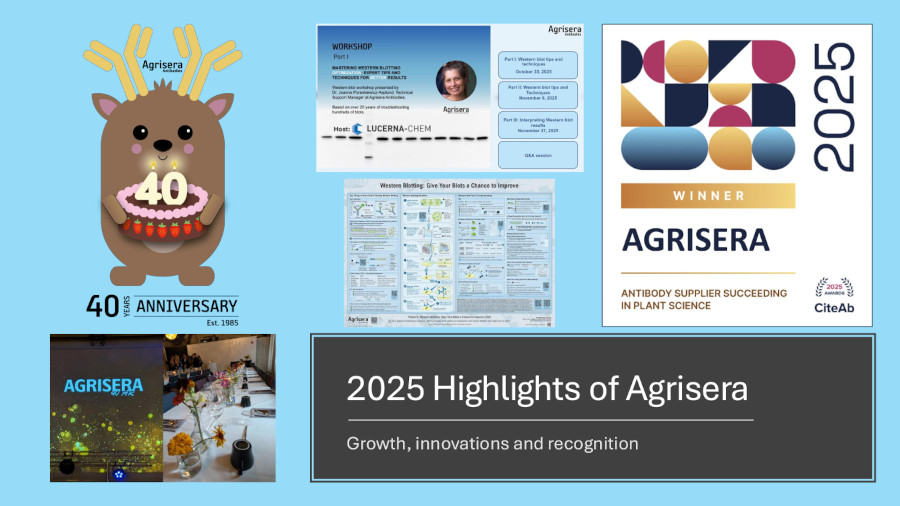
2025 Highlights!

Agrisera Celebrates 40 Years and the CiteAb Award

In 2025, Agrisera proudly celebrated 40 years of supporting the global plant and algal research community, a milestone year marked by growth, innovation, and recognition.
🌱

🌍 Agrisera participated in 9 international meetings and supported a total of 24 conferences worldwide.
🏆 10 Agrisera Best Poster and Best Talk Prizes were awarded at scientific conferences around the world.
🌍 144 conferences, webinars and workshops  were listed in The Global Plant Events Calendar, which Agrisera is running together with ASPB/Plantae
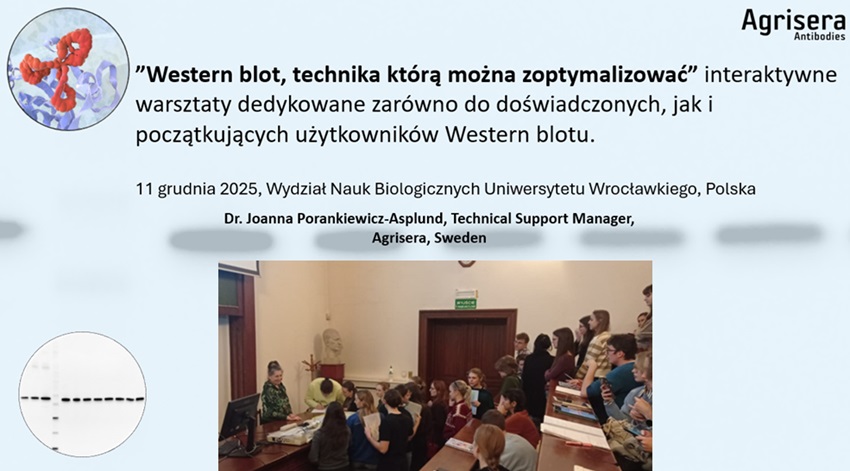
💻 12 technical online workshops brought together hundreds of researchers from across the globe.
📝 Practical insights were shared through 16 technical blog posts.
📊 New method poster, focused on Western blot technique was launched
📊 More than 3,000 printed Agrisera Educational Posters were distributed to research laboratories worldwide.
🔬 Over 100 antibodies were provided free of charge to support ongoing research efforts.

🏅 Adding to this landmark year, Agrisera was honored with the CiteAb Award for the most successful antibody supplier in plant science, recognizing our antibodies’ outstanding impact based on publication records.  

We are proud to contribute to the growth of the scientific community and look forward to meeting you at upcoming conferences and workshops in 2026!


 2025 Highlights of Agrisera Antibodies


Read more 2025-12-22

Interview with Prof. Debabrata Laha

Prof. Debabrata Laha

Debabrata

Dr. Debabrata Laha is a professor at the Department of Biochemistry, Indian Institute of Science (IISc), Bangalore, where his laboratory investigates how inositol pyrophosphate messengers influence plant physiology and adaptation to uncover the molecular processes that enable sessile plants to cope with shifting environmental stresses.


- Please tell us about yourself and your research/institution.

I started my laboratory at the Department of Biochemistry, Indian Institute of Science (IISc), Bangalore during pandemic time, almost 5 years back. IISc is a premiere research institute of India and provides excellent platform for conducting multidisciplinary research. My lab investigates the contribution of inositol pyrophosphate messengers in controlling various aspects of physiology, growth and development and immunity in land plants.


- What motivated you to get into plant science?

Land plants are sessile, yet they must cope with countless stressors to survive. What are the molecular processes that plants have evolved to adapt to an ever-changing environment? Are these molecular mechanisms shared across different clades of land plants? We are very excited to explore the answers to some of these open questions.


- How have you used (Agrisera) antibodies in your research?

I have been using Agrisera antibodies since my PhD time at the University of Tübingen, Germany. I find them to be an excellent resource for the plant science community. In our laboratory, Agrisera antibodies are routinely employed in various experiments. For example, we have used the anti-RGA (DELLA) antibody to investigate the potential role of inositol pyrophosphate messengers in regulating DELLA protein levels in Arabidopsis thaliana (Rana et al., Nat Chem Biol 2025).


Links

• Prof. Debabrata Laha
• Agrisera antibody to RGA (DELLA)
Read more 2025-12-10

Agrisera Prize at Umeå Plant Science Centre 2025

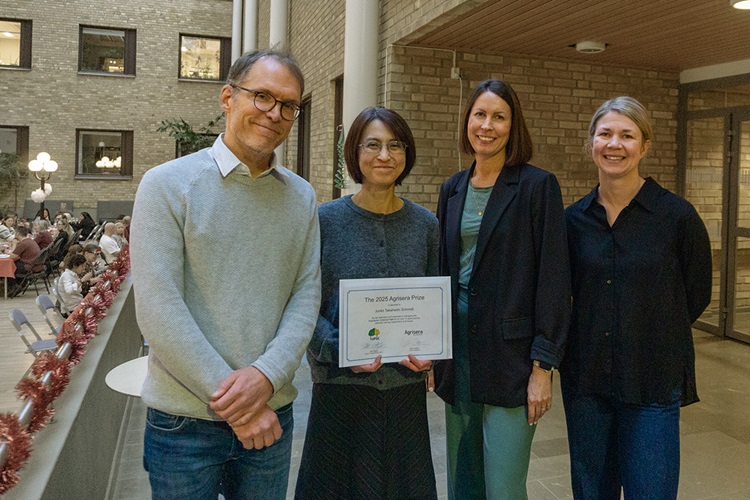
Our warmest congratulations to Dr. Junko Takahashi Schmidt who was awarded the 2025 Umeå Plant Science Centre (UPSC) Agrisera Prize!

Each year, UPSC honours scientific achievements and contributions to improving the work environment with the UPSC Agrisera Prize. 

The UPSC Agrisera Prize 2025 is awarded to Dr. Junko Takahashi Schmidt for her dedication and expertise in managing the Biopolymer Analytical Platform for over 15 years and for patiently training researchers at all levels.

The Biopolymer Analytical Platform — often known internally as the “cell wall lab” — provides an extensive suite of methods for analysing plant cell walls and biomass. But the platform’s success relies heavily on the remarkable expertise and dedication of Junko Takahashi Schmidt. UPSC now recognizes her outstanding contributions in keeping the platform running smoothly and her unwavering commitment to sharing her knowledge with others.


 Xmas lunch at Umeå Plant Science Centre and Agrisera Prize

In the image, left to right: Dr. Totte Niittyla (UPSC), Dr. Junko Takahashi Schmidt (UPSC), Jenny Hesselgren (Agrisera) and Fanny Sundelin (Agrisera).
(Photo: Anne Honsel).
Read more 2025-12-05
 Agrisera News

Archive

ARTICLE 1-6 6.1  | Show all 
Close